Adobe Experience Manager - Navigate AEM flavors in 2025

This short guide helps you navigate the current Adobe Experience Manager (AEM) offerings. With brief explanation what exists today, how it evolved, and when to choose each flavor.
Adobe Experience Manager (AEM) is a comprehensive content management platform. As Adobe describes it, AEM brings together content and asset management, digital forms, and learning tools to deliver the right content when and where users need it.
AEM’s roots trace back to Day Software (Basel, Switzerland), which built early web content management systems in the 1990s. Its key products were CRX (Content Repository eXtreme) and CQ (Communiqué) that became the foundation of AEM. A pivotal milestone in early years was CQ5 in 2008, which integrated CRX and a JCR‑compliant backend (Java Content Repository).
Adobe acquired Day Software in 2010 and integrated CQ into the Adobe Marketing Suite. CQ was later rebranded as Adobe Experience Manager (AEM) and matured through multiple releases to AEM 6.5 and AEM as a Cloud Service.
A Journey to the Cloud
Modern AEM Platform Options
Key Considerations: Which AEM Is Right for Your Organization?
A Journey to the Cloud
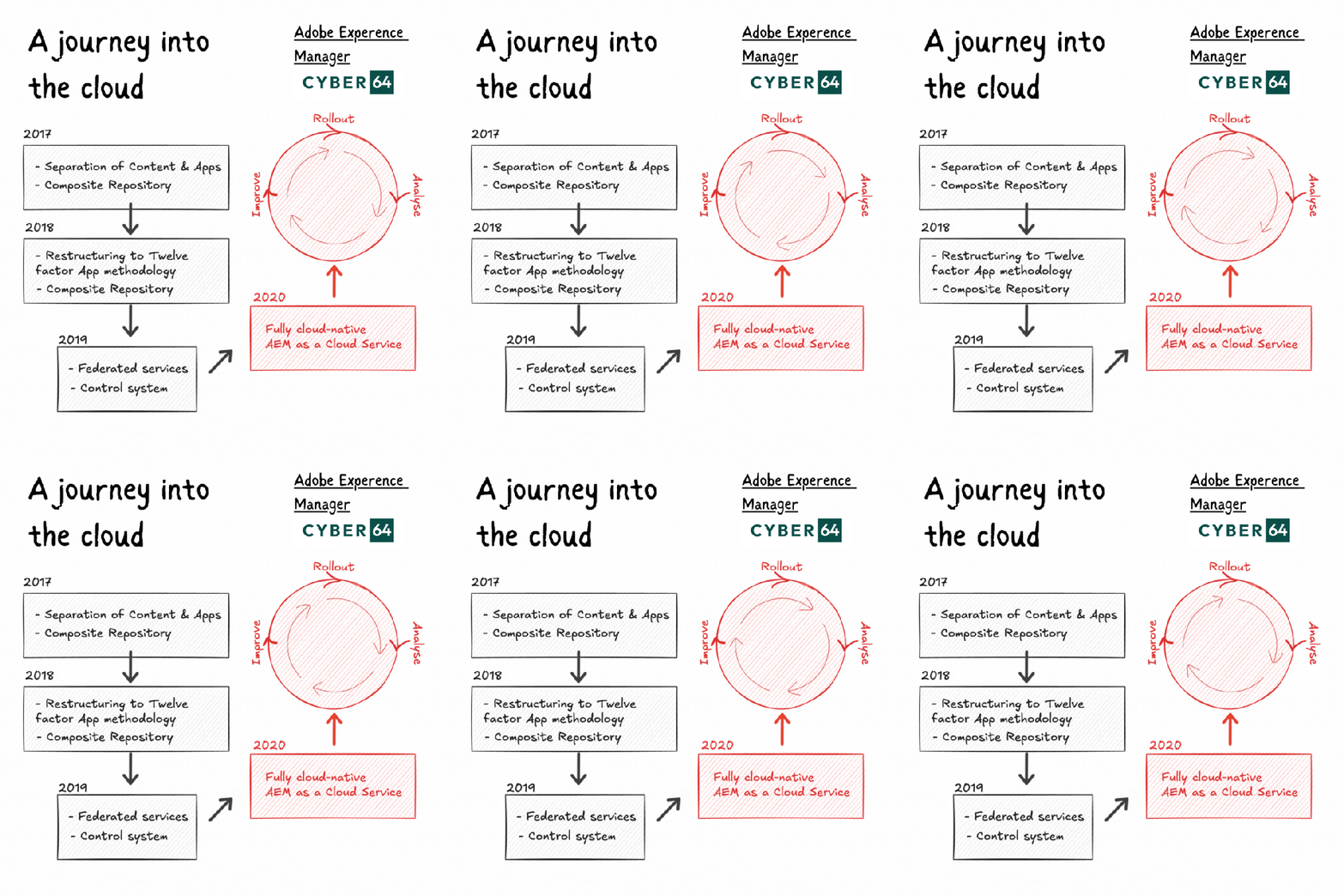
More important than discussion on individual AEM versions is the evolution that enabled AEM to run efficiently at cloud scale. Here are most important milestones:
- 2017 Composite Repository - Clear separation of application (customer implementation) and content served to end users.
- 2018 Twelve‑Factor & Containerization - Restructuring aligned to the Twelve‑Factor App methodology and container‑friendly patterns.
- 2019 Federated Services & Control Plane - Extraction and centralization of key services.
- 2020 Cloud‑Native Launch - AEM as a Cloud Service (AEMaaCS) becomes generally available.
Modern AEM Platform Options
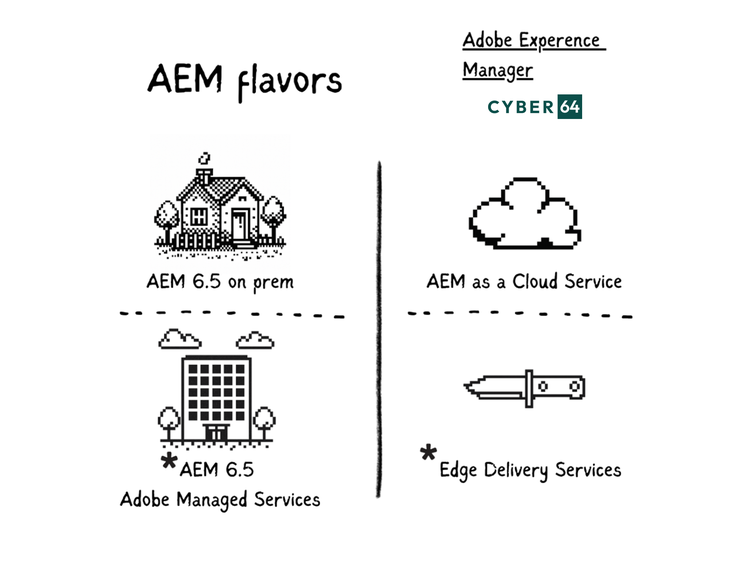
Today, organizations most often choose between the AEM 6.5 (including Long‑Term Support, LTS) and the cloud‑native AEM as a Cloud Service (AEMaaCS), which can be extended with Edge Delivery Services (EDS).
AEM 6.5 / LTS
AEM 6.5 / LTS is the right fit when you need deep control over the stack and extensive customization. It’s especially suited to organizations with complex integrations and specialized compliance requirements, mature DevOps practices, and strict change-management or data-residency constraints.
- Deployment flexibility — Self‑hosted (on‑prem or customer cloud) or Adobe Managed Services (AMS)
- Robust customization — Full backend and infrastructure access
- Long‑term stability — Ongoing service packs and LTS support for mission‑critical programs
AEM as a Cloud Service
Built for the cloud‑first era, AEMaaCS emphasizes scalability, resilience, and automation—reducing operational overhead versus traditional hosting.
- Built‑in CDN & autoscaling — Adapts to traffic spikes for performance and availability
- Subscription model — Usage‑aligned licensing suited to evolving digital portfolios
- Native support for both traditional (headful) or headless editing
- Two authoring frameworks — Continue the classic author‑publish‑dispatcher model or adopt a document‑based approach backed by Edge Delivery Services
AEM as a Cloud Service offers two distinct approaches (or frameworks) that can be used separately or side-by-side, each with its own trade-offs for content management and customization.
The classic Author/Publish/Dispatcher approach provides a web UI and APIs for content management. Development and implementation is done via classic AEM stack (including Java and HTL) with deployments handled by Cloud Manager CI/CD. This approach supports traditional (headful) editing through the Page or Universal Editor and headless delivery via Content Fragments.
The document-based approach with Edge Delivery Services enables fast, lightweight, document-centric authoring. It adds a edge‑rendered delivery model that prioritizes performance, simplicity, and content velocity. It leverages Adobe's DA Editor or tools like Microsoft Word and Excel or Google Docs and Sheets. In-context editing is also supported through the Universal Editor.
- Serverless, CDN‑driven delivery — Globally distributed outputs for fast, resilient experiences
- Universal Editor & low‑code authoring — Empower authors to build pages with reusable blocks and in‑context editing
- Composable architecture — Start quickly, scale cleanly, and reuse content across sites and channels
Key Considerations: Which AEM Is Right for Your Organization?
Licensing
Licensing models differ among AEM offerings. AEM 6.5 LTS provides both perpetual and subscription options, while AEM as a Cloud Service and Edge Delivery Services operate on consumption-based models that may require organizations to adapt from traditional licensing structures. Licensing part on Cloud is very important, because the quality and approach behind your implementation can drastically influence the overall cost of ownership.
To learn more about optimization of AEMaaCS license costs, consult this great article from my colleague Matija Kovaček - How To Lower AEMaaCS License Costs: 5 Cost-Reduction Tips To Save https://cyber64.com/blog/how-to-lower-aemaacs-license-costs-5-cost-reduction-tips-to-save/
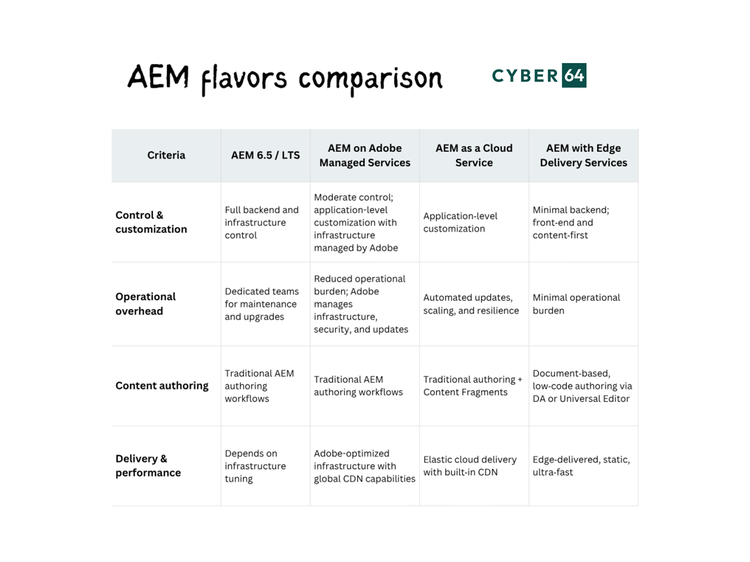
Comparison Summary
- If you need maximum control and complex custom integrations, choose AEM 6.5 LTS.
- If you want cloud‑native agility and automated operations, choose AEM as a Cloud Service.
- If you prioritize speed and streamlined authoring, especially for marketing sites and rapid campaigns, choose AEM with Edge Delivery Services.
Final Thoughts
Adobe Experience Manager has matured into a solution that can power wide range of applications. From highly customized enterprise platforms to ultra‑responsive, content‑heavy marketing experiences. Understanding the trade‑offs among AEM 6.5/LTS, AEMaaCS, and EDS will help you align technology choices with evolving business goals in 2025 and beyond.