Adobe Experience Platform Agent Orchestrator: From Assistants to Autonomous Agents
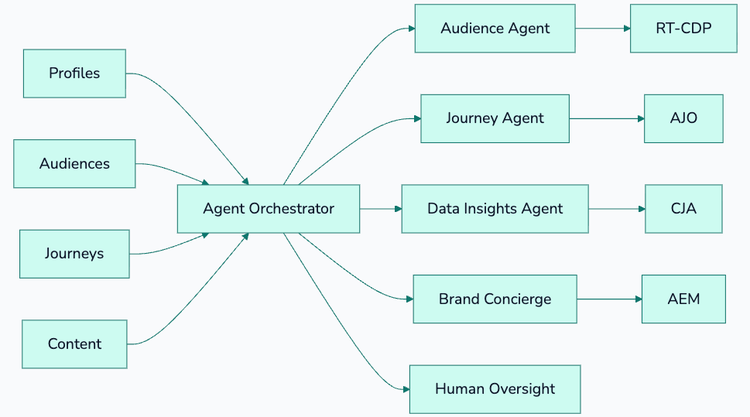
Adobe unveiled Agent Orchestrator at Summit 2025 in March and made it generally available in September 2025. It is the agentic AI layer inside Adobe Experience Platform that powers a suite of purpose-built agents across Experience Cloud.
This is not a chatbot. It is a reasoning engine that connects to AEP's real-time customer data, plans multi-step workflows, and executes them with human oversight. The agents it powers are already shipping inside Real-Time CDP, Journey Optimizer, Customer Journey Analytics, and AEM.
This article covers what Agent Orchestrator is, what agents are available, and how this connects to the broader Adobe AI strategy heading into Summit 2026.
What Agent Orchestrator Does
The Agents
Brand Concierge
How This Connects to MCP
What Agent Orchestrator Does
Agent Orchestrator sits between the AI models and the Experience Cloud applications. It provides three core capabilities:
- Reasoning.The orchestrator interprets a task, breaks it into steps, and determines which tools, data sources, and actions are needed. It does not just respond to prompts. It plans.
- Knowledge. It draws on AEP's unified customer profiles, audience definitions, journey data, and content repositories. Every decision is grounded in your first-party data, not generic training data.
- Coordination. It manages the execution of multiple agents and actions, handling dependencies between steps, monitoring outcomes, and adjusting when results do not match expectations.
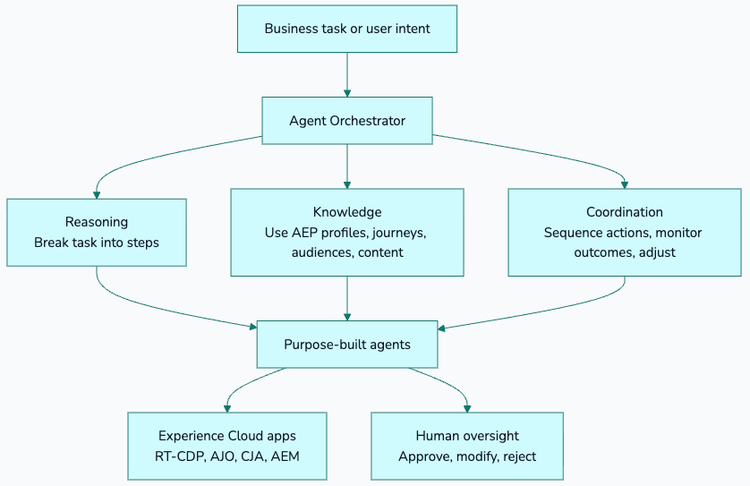
The human oversight model is built in. Agents propose actions. Humans approve, modify, or reject. The degree of autonomy is configurable per agent and per organization.
The Agents
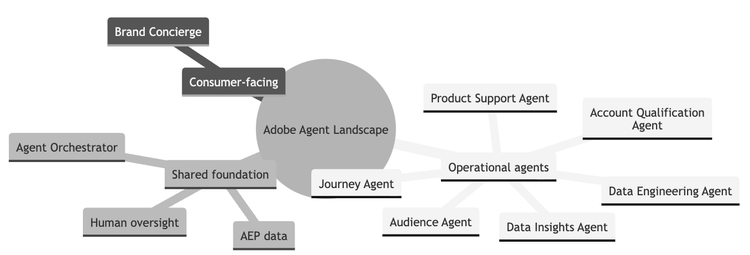
Adobe has shipped ten purpose-built agents. Here are the ones most relevant to marketing and experience teams.
1. Audience Agent
Find it in Real-Time CDP.
The Audience Agent works with your audience inventory in Real-Time CDP. It can:
- Surface insights about specific audiences, including composition and overlap
- Detect duplicate audiences that waste activation spend
- Monitor significant audience size changes and alert you to unexpected shifts
- Help you explore and understand your full audience inventory
This replaces the manual work of auditing audience definitions, a task that becomes unmanageable as organizations scale past dozens of segments.
2. Journey Agent
Find it in Adobe Journey Optimizer.
The Journey Agent creates and analyzes customer journeys through natural language. Ask it to build a journey and it constructs the flow, selects channels, and sets conditions. Ask it to analyze an existing journey and it identifies drop-off points, schedule conflicts, and performance patterns.
Key capabilities:
- Create journeys from natural language descriptions
- Detect and resolve scheduling or audience conflicts between journeys
- Analyze journey performance and identify drop-off points
- Identify top-performing journeys as templates for future campaigns
3. Data Insights Agent
Find it in Customer Journey Analytics.
The Data Insights Agent answers questions about your analytics data in natural language. It builds visualizations directly in Analysis Workspace using your data view components and your actual data.
This is different from a generic AI answering questions about analytics concepts. It operates on your specific data, your dimensions, your metrics, your segments. The output is a working Analysis Workspace visualization, not a text summary.
4. Account Qualification Agent
Find it in Real-Time CDP (B2B edition).
For B2B organizations, the Account Qualification Agent evaluates new opportunities, advances pipeline, and aligns sales and marketing teams around buying groups. It uses account-level signals from AEP to determine which accounts are ready for engagement and which need further nurturing.
5. Data Engineering Agent
Find it in Adobe Experience Platform.
Handles the operational work of data management: cleansing, integration, and governance. The kind of work that data engineers spend hours on, normalizing field formats, resolving identity conflicts, ensuring compliance with data governance policies.
6. Product Support Agent
Find it in Experience Cloud (cross-product).
An AI agent trained on Adobe's product documentation and support knowledge base. It assists with troubleshooting, configuration questions, and best practice guidance.
Brand Concierge
Brand Concierge is different from the operational agents above. It is a consumer-facing application.
It turns your digital properties (websites, apps, commerce storefronts) into conversational AI experiences. Visitors interact with your brand through natural dialogue. The agent answers questions, makes recommendations, and guides users through their journey, all powered by your first-party data and brand content.
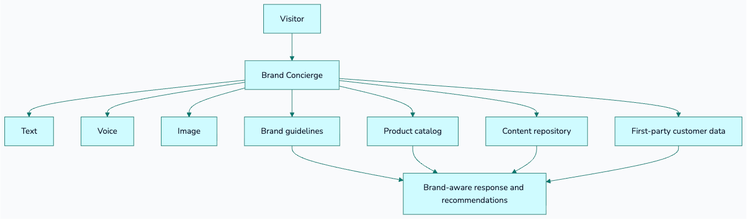
Key characteristics:
- Multimodal. Supports text, voice, and image interactions.
- Brand-aware. Responses are grounded in your brand guidelines, product catalog, and content repository.
- First-party data powered. Recommendations draw from AEP's unified customer profiles, not generic product descriptions.
- B2C and B2B. Supports both consumer-facing and business-facing use cases.
The context for Brand Concierge is Adobe's own data: AI traffic to U.S. retail sites increased 1,200% year-over-year as of early 2025. Consumers are increasingly arriving at brand properties through AI-mediated experiences. Brand Concierge is Adobe's answer to ensuring brands control that conversation.
How This Connects to MCP
If you have read the earlier articles in this series on AEM MCP servers, the relationship is worth making explicit.
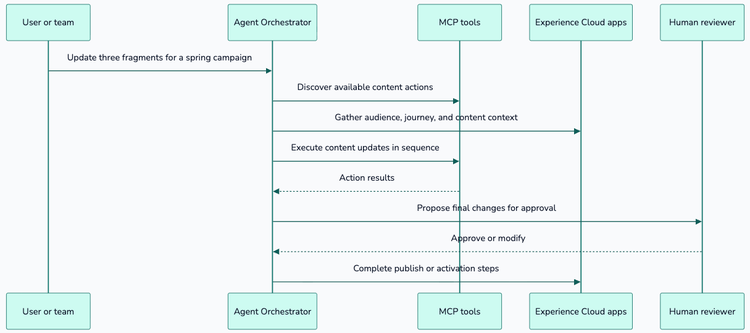
MCP (Model Context Protocol) is the tool layer. The AEM Content MCP server exposes 60+ operations, search fragments, create launches, patch content, publish. These are the actions an AI can perform.
Agent Orchestrator is the reasoning layer. It decides which actions to take, in what order, based on the task and the available data. It plans multi-step workflows and coordinates execution across multiple tools and data sources.
In the MCP workflow I demonstrated on WKND, I described the intent ("update three fragments for a spring campaign") and the LLM figured out the operation sequence. That is the same pattern Agent Orchestrator uses at a much larger scale, connecting not just to content operations but to audience data, journey definitions, analytics, and activation channels.
AI assistants that respond to individual prompts are giving way to AI agents that plan and execute complex workflows across systems. MCP provides the hands. Agent Orchestrator provides the brain.
Summit 2026 and the Agentic Web
Adobe Summit 2026 runs April 19-22 in Las Vegas. The track names reveal the strategic direction:
- "Brand Visibility and Content Management in the Agentic Web"
- "Content Supply Chain for the AI World"
- "Orchestrating Experiences with AI Agents"
- "Enterprise Productivity for High-Performing Teams"
The word "agentic" appears in multiple track titles. This is not a feature announcement cycle. It is a platform narrative shift. Adobe is positioning the entire Experience Cloud as an agent-native platform where AI agents, both internal (marketing operations) and external (consumer-facing), are the primary interaction model.
For practitioners, the implication is that understanding agent architecture, how agents reason, what data they access, how they coordinate, is becoming as important as understanding the individual products those agents operate on.
What This Means for Teams?
Marketers
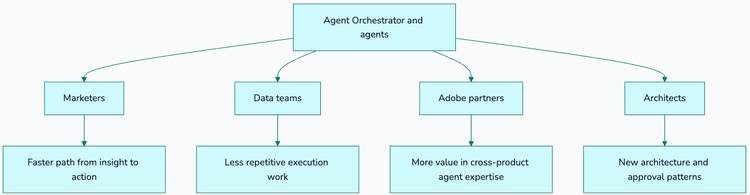
The Audience and Journey agents reduce the time from insight to action. Instead of filing tickets to build segments or waiting for analysts to identify journey drop-offs, you describe what you need and the agent delivers. The human review step remains. The manual construction step is what changes.
Data teams
The Data Engineering and Data Insights agents handle the repetitive work, data cleansing, format normalization, ad hoc reporting. This does not eliminate the data engineering role. It shifts the focus from execution to oversight and strategy.
Adobe partners
Agent Orchestrator is becoming the unifying layer across Experience Cloud. Partners who understand how to configure, customize, and extend agents will be better positioned than those who only know individual product UIs. The agent taxonomy (which agent does what, where it lives, what data it accesses) is foundational knowledge for 2026 and beyond.
Architects
The MCP & Agent Orchestrator combination represents a new integration pattern. Instead of building point-to-point integrations between Adobe products, agents can coordinate across products through the orchestrator. Architecture discussions should now include: which tasks are candidates for agent automation, what data do those agents need, and what are the approval workflows.