Adobe Summit Insights: AEM Guides, Structured Content and the Future of AI-Ready Documentation

Documentation is no longer just documentation.
That was one of our strongest takeaways from Adobe Summit and the AEM Guides preconference. As AI becomes part of more digital experiences, content becomes the foundation those experiences depend on.
Users do not always want to search, filter and read through long articles to find one answer. Today, users expect information to be delivered in the moment, through chat, support tools, product interfaces and AI-driven experiences.
The sessions gave us a clear view of where content is heading:
- More automation
- More AI
- Stronger content supply chains
- Faster delivery of digital experiences
But what made the event especially valuable was that these topics were connected to real challenges we see in projects every day: legacy content, complex documentation, disconnected formats and teams that need to deliver content faster without losing quality.
The message was clear: content still matters, but structure, metadata and context are what make it useful at scale. One idea from the Summit captured the shift well: content teams are moving from writers of pages to designers of systems. That is why structured content matters - it helps organizations create content that is reliable, reusable and ready for automation and AI.
DITA migration is the hard part - but it pays off
Authors need support too
A better editor experience is coming
AI needs structured content behind it
Guides AI: from suggestions to action
AEM Guides APIs and Java SDK: automation at scale
Our takeaway
DITA migration is the hard part - but it pays off
One of the biggest challenges for many companies is moving existing content into DITA. This is rarely just a technical conversion. Most organizations have years of documentation in different formats, with duplicated sections, inconsistent structure, outdated content and different writing styles. Moving to DITA means more than transforming content. It also means cleaning it up, defining reusable topics, improving metadata and building a better content structure for the future.
It takes time and it needs good planning. It also requires cooperation between authors, subject matter experts, reviewers, information architects, developers and business stakeholders.
But once this work is done, the benefits are clear. Content becomes easier to reuse, translate, review, update and publish. Instead of maintaining the same information in many places, teams can manage it from one structured source. As one of the sessions put it: DITA is a strategic asset, not a formatting choice. The migration can be difficult, but it creates the foundation for a much better content process later.
Authors need support too
Author adoption is another key consideration. For teams used to working in Word, PDFs, InDesign or traditional CMS pages, structured authoring can feel unfamiliar at first. It is not only a new tool, but also a new way of thinking about content. Instead of creating long, standalone documents, authors begin working with smaller reusable topics, metadata, references, maps and content relationships. That shift takes time. Authors need training, support and space to become comfortable with the new approach.
The platform only delivers its full value when people understand both how to use it and why the content model matters.
What we heard at the event and what we also see in practice, is that this mindset shift becomes easier over time. Once authors understand the new way of working, satisfaction increases because the benefits become clear. They spend less time on repetitive formatting, copying and manual updates and more time improving the quality and usefulness of the content itself.
A better editor experience is coming
One of the most practical updates showcased at the conference was the new editor experience planned for the upcoming May release. The new editor looks cleaner and more modern, but the bigger improvement is usability. It is designed to make daily authoring easier and faster.
A useful improvement is the side-by-side view, where authors can work in the editor and XML source at the same time. This matters because different users work differently. Some prefer a visual authoring experience, while advanced users often want direct access to XML.
The editor is also designed to handle very large volumes of content without slow loading times. Even maps with thousands of topics can load almost instantly. That kind of performance can make a huge difference in daily work. Less waiting means smoother navigation, faster updates, fewer frustrations and better adoption across authoring teams.
AI needs structured content behind it
AI was one of the biggest topics across the Adobe ecosystem, but the message was not simply “AI will solve everything.” The more important point was that AI is only as good as the knowledge behind it.
If enterprise content is outdated, duplicated, inconsistent or missing clear sources, AI will struggle. Answers can become incorrect, versions can get mixed and teams will quickly lose trust, especially in support, documentation and customer-facing use cases. If the source content is messy, AI will not magically fix it. In many cases, it will simply make those problems more visible.
This is where AEM Guides becomes especially powerful. It can serve as an excellent content foundation for AI because it is built around structured, governed and reusable content. DITA gives AI agents a strong data model to work with:
- Content is broken into clear topics
- Content is enriched with metadata
- Content is connected through maps
- Content is managed through defined relationships.
The Guides Knowledge AI concept showed this direction very well. AEM Guides content and metadata can feed knowledge domains and knowledge graphs. From there, the same trusted content can be used through APIs, MCP, chatbots, Slack and other digital experiences.
In simple terms: AEM Guides can become an amazing knowledge base for AI, turning structured content into the trusted layer that powers future AI-driven experiences.
Guides AI: from suggestions to action
We also heard more about Guides AI and this was one of the more exciting directions presented. What makes it interesting is that it is not only about AI giving suggestions or generating content. The direction is more practical: agentic AI that can help perform actions inside the content workflow. This means AI could support authors not only by recommending improvements, but by actually helping with tasks such as creating content, tagging content, improving metadata, finding reusable topics, preparing content for review or supporting publishing steps.
That is an important shift. Instead of AI being only a writing assistant, it becomes more like a workflow assistant that understands the content structure and can help move work forward. Of course, AI will not replace content strategy, governance or expert review. These will still be essential. But agentic AI can reduce repetitive manual work, make large content operations easier to manage and help teams work faster while keeping control over quality.
As AI-driven experiences continue to grow across chat, voice, guided workflows and other digital interfaces, they will depend on trusted structured content that can be reused consistently from a single reliable source.
AEM Guides APIs and Java SDK: automation at scale
Another strong topic was the API capability in AEM Guides 5.1.0, which makes it easier to automate content workflows and connect AEM Guides with other enterprise systems.
AEM Guides exposes REST APIs across several areas of the platform, including:
- Assets
- Baselines
- External data sources
- Feature flags
- The Guides Editor
- Publishing
- Reporting
- Review
- Translation
- Utilities
- Workfront
- AI Assistant capabilities
These APIs give developers a practical way to automate workflows, connect AEM Guides with enterprise applications and extend functionality programmatically across the content lifecycle.
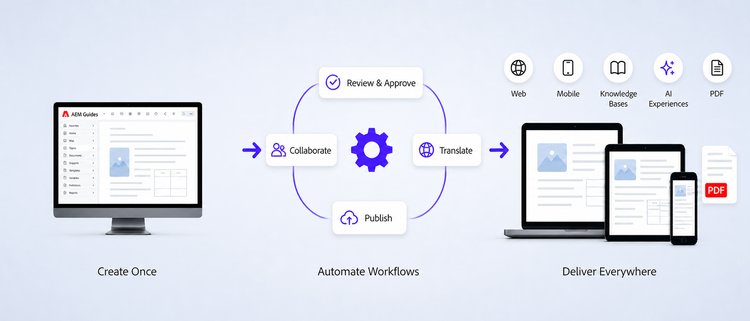
For Java-based implementations, the typed Java SDK API reference provides a more structured way to build extensions and integrations using Java.
For implementation teams, this means less manual work, faster integrations and more reliable automation. It also makes it easier to move from content creation to market more efficiently, because approved content can be pushed through connected workflows instead of handled manually step by step.
The main benefit is speed, control and long-term reliability. Teams can automate more of the content lifecycle while staying closer to Adobe’s supported product roadmap and maintenance.
Our takeaway
Adobe Summit and the AEM Guides preconference confirmed one clear message: structured content is becoming the foundation for AI-ready content experiences. As companies move toward more automation, AI and multi-channel delivery, they need content that is trusted, reusable, governed and easy to activate. AEM Guides is moving strongly in this direction, with better authoring, automation, AI-focused capabilities and API-driven integration.
For us at Cyber64, the value of the Summit was not only in the product updates, but also in the conversations with Adobe experts, partners and teams facing similar challenges. Those discussions confirmed what we see in real projects: modernizing complex documentation, improving content governance and preparing content operations for automation and AI takes effort, but the long-term value is significant.
Structured content is no longer just a documentation improvement. It is a strategic foundation for scalable, trusted and future-ready digital experiences.

Martina Mikolić
Subject Matter Expert - AEM Guides | AEM Technical Architect
- @martinaricijas
- martina.ricijas@cyber64.com