Adobe Target 101 - Part 1: Testing or Personalization?

Join me in this Adobe Target series, where I discuss testing and personalization, integration approaches, and the implementation of use cases.
So, should we test or personalize?
How many variants and what type of variations?
How long should we test before making conclusions?
Experience Targeting or Who sees what?
Can we finally dive deep into Target?
Adobe Target is a personalization and testing solution and it is a part of Adobe Experience Cloud products suite. Goal of Target is to provide capabilities for customer experience optimization and experimentation across various channels. With the possibility to implement on both client and server side, it offers a robust framework for diverse use cases and activation strategies.
2025 Gartner® Magic Quadrant™ for Personalization Engines puts Adobe Target among leaders.

To understand this position, let’s quickly glance at the evaluation criteria used in the report. There are two main areas — Ability to Execute and Completeness of Vision*. Gartner puts the most weight on Product / Service quality and Overall Viability for a vendor’s Ability to Execute, and on Market Understanding and Offering Strategy for Completeness of Vision.
Adobe Target is a strong choice when selecting a personalization and testing solution, especially if the organization already has other solutions from Adobe Experience Cloud, and if Adobe Experience Manager is used as the main CMS and DAM solution. We will revisit this in the following articles covering Target integration capabilities.
So, should we test or personalize?
Before diving into capabilities and implementation strategies for Adobe Target, let’s discuss what testing and personalization actually are. Personalization, testing, optimization, and experimentation are often used together, but they represent different approaches to improving the customer experience and achieving business KPIs. I won’t delve into the full hierarchy of these terms and for the sake of simplicity let’s divide them into testing and personalization.
Testing provides site-wide optimization and risk mitigation, personalization delivers audience-specific tailoring and loyalty growth, and their overlap produces shared learnings, stronger KPIs, and an enhanced customer experience. To quickly summarize, here is a simple graphic inspired by blog from one of Adobe Target’s competitors.
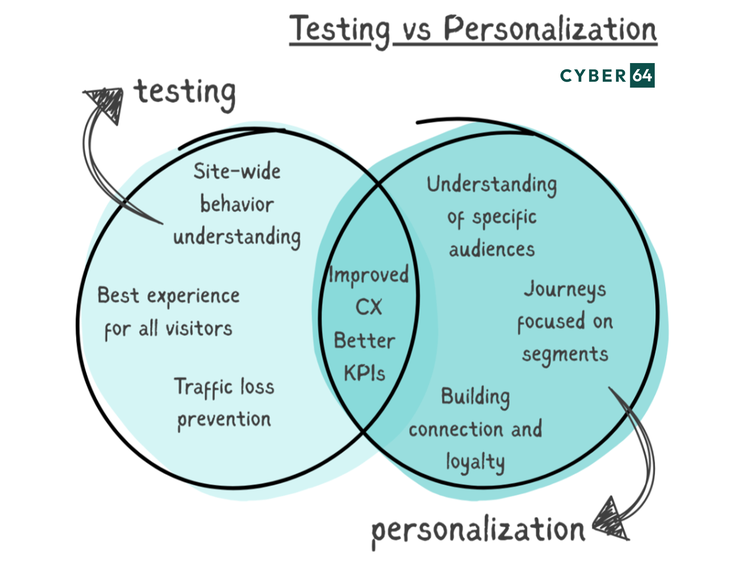
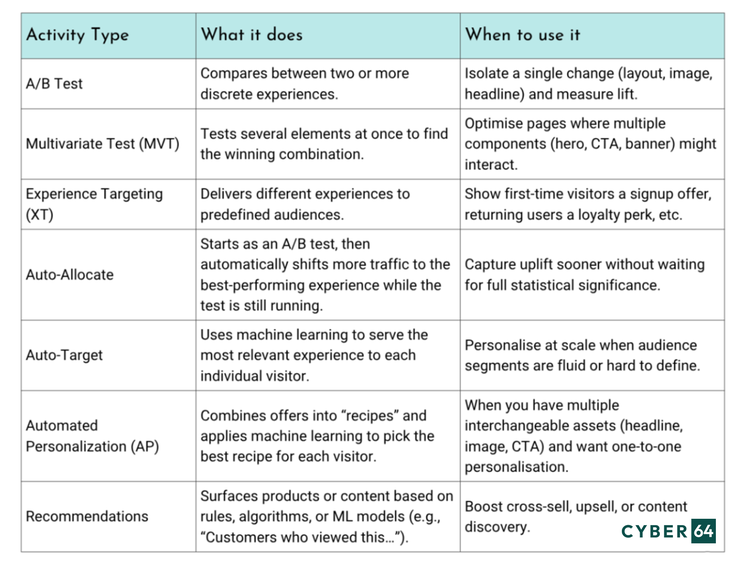
Let’s map this to Adobe Target capabilities. Target uses Activities, workflows with several predefined steps that let you set up your testing and personalization efforts. Below is a list with high‑level explanations.
How many variants and what type of variations?
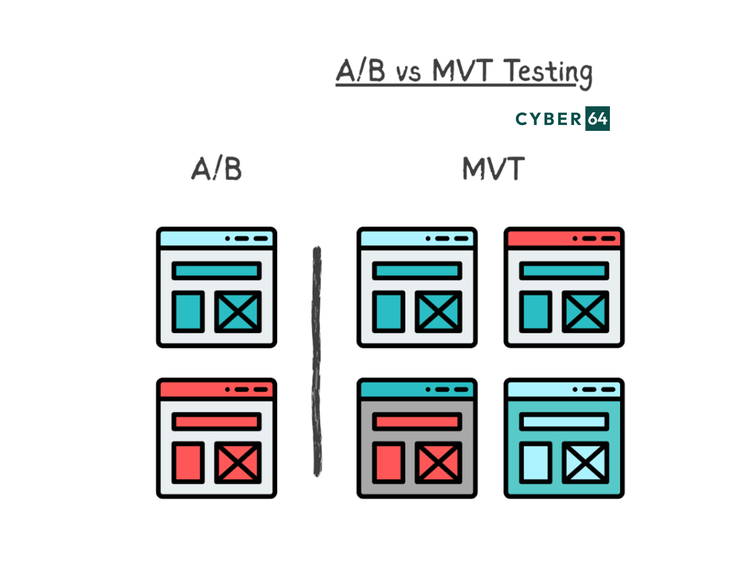
Let’s look at the two main categories of tests available in Adobe Target, A/B testing and multivariate testing (MVT).
Use A/B testing to compare distinct versions of a page, app, ad, or other large section to determine which performs better against your defined metrics. It is best suited to situations where you want to test a single, isolated change—for example, a layout tweak, a different image, or a new headline—and see whether it positively affects user behavior and conversions.
Use multivariate testing (MVT) when you need to understand how multiple elements on a page interact and influence overall performance and conversion. MVT is helpful when you have several moving parts—such as images, calls to action, and copy—and want to find the combination that produces the best user experience.
How long should we test before making conclusions?
If we try to interpret results too early and promote a “winning” experience before we reach statistical significance, we risk making critical business decisions based on false data. Statistical significance expresses the probability (the p-value) of obtaining a false-positive result; in other words, the p-value represents the likelihood that an observed outcome is due to randomness rather than a real effect.
Numerous resources explain statistical significance and how to apply it. Below is a brief guide to calculating sample size with Adobe’s Sample Size Calculator.
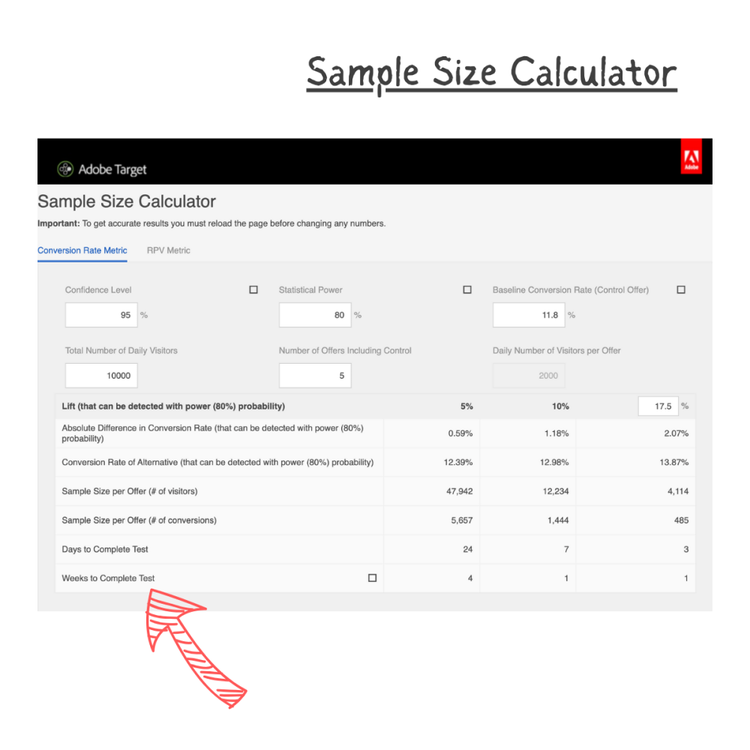
How to fill in the data:
- Confidence level: 95%
- Statistical power: 80%
- Total Number of Daily Visitors: Unique Visitors value for the page where test will be execute divided this value by the number of days
- Baseline Conversion Rate (Control Offer): Number of conversions you are testing divided by Total Number of Daily Visitors
- Number of Offers: Input number of variants, including control
As with other statistical tools, statistical significance should be applied thoughtfully and in the proper context. Its importance in MarTech is lower than in scientific research, so you can tolerate a slightly wider margin.
Experience Targeting or Who sees what?
Experience Targeting (XT) is Target’s rule‑based personalization capability: instead of splitting traffic like an A/B test, you decide in advance which audience gets which experience.
While an A/B test asks which variant wins?, XT asks who should see each variant in the first place? The setup feels familiar—define experiences, set metrics—but the allocation engine reads visitor attributes and serves the predetermined match every time.
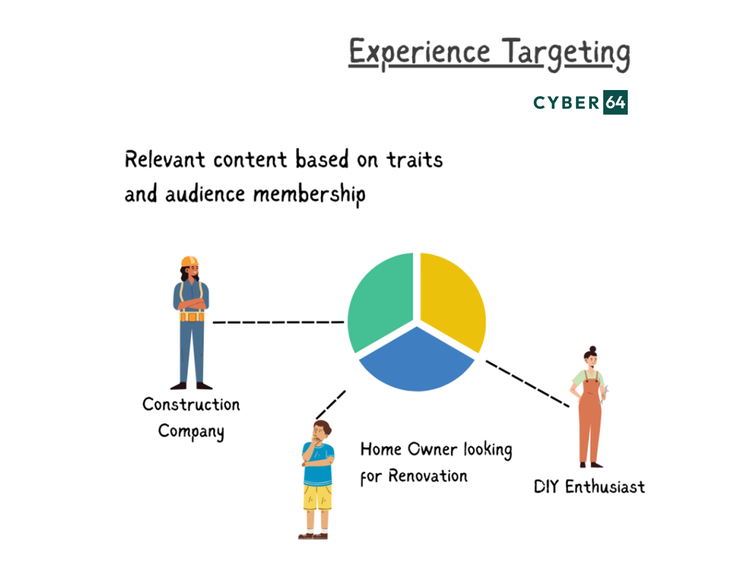
That deterministic control means your promotion banner can stay glued to specific customer segment even while the rest of the site runs experiments. Think of XT as the next step after A/B testing: same workflow, same reporting, but a targeting switch that trades statistical proof for guaranteed relevance.
Can we finally dive deep into Target?
Almost. Before we start integrating, developing, and testing, we need to define our use cases and plan our tests. We'll cover this in the next article in the series.