Adobe Target 101 - Part 2: From Vision to Variant
Personalization drives growth only when it is proven by testing and supported by the right people and processes. This guide combines ideas about rollout with a practical, repeatable loop so organizations can turn ideas into measurable revenue quickly and consistently.
Why test first, then personalize? To repeat from the previous article, customers expect tailored experiences. Using untested rules and experiments on a large audience can waste time and hurt trust. Testing clarifies who to target, where to intervene, and what to change. It lowers risk and builds confidence to scale what works.
Testing and personalization initiative
Plan - Design - Implement - Measure - Iterate
Short example instead of conclusion
Testing and personalization initiative
Share a common vision across marketing, sales, and other relevant teams. Treat personalization as a company initiative. Align all channels and customer touchpoints around outcomes, workflows, and governance so every activity supports revenue, retention, or efficiency. Technology and capabilities set the ceiling, but people and processes determine how high the actual implementation can fly in real‑world use.
Work on Adobe Target and on testing and personalization more broadly is often approached from isolated or biased perspectives, and there is rarely a shared understanding of what will be done and why. As noted earlier, personalization fails more often because of organizational drag than because of tooling or capability gaps.
One organizational model that worked in a previous project can be described with the POD model. Typical roles include Marketing Strategist, Data/Analytics Lead, UX/UI Designer, Front‑end & Back-end Developer, and QA/Privacy Gatekeeper.
Good approach is to always emphasize small iterations, frequent adjustments, and continual evolution. Adobe Target and similar tools enable you to act quickly, don't let your team to slow down changes, evolution, and improvements of your experiments.
Plan - Design - Implement - Measure - Iterate
Example iterative process to turn ideas into outcomes. Start each cycle with a KPI and finish with a clear decision to scale, refine, or stop.
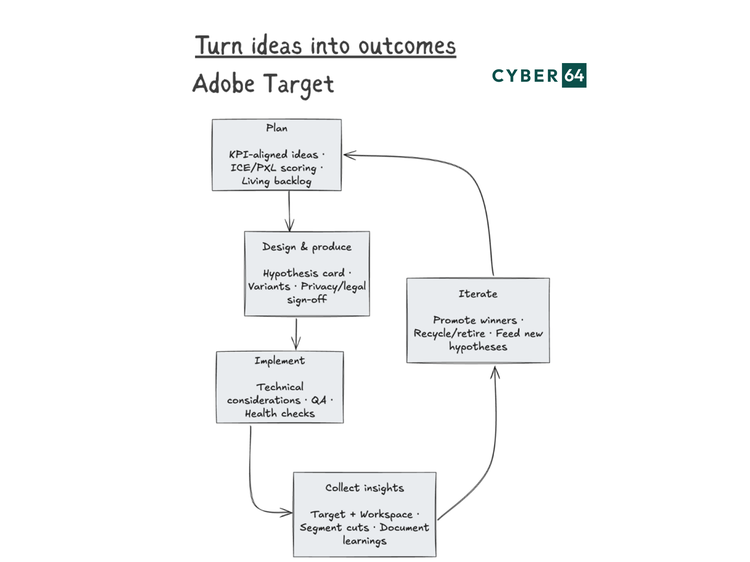
Plan
Find opportunities that map to your KPIs using analytics, voice of customer, and competitive research. Score each idea with an ICE or PXL matrix for impact, confidence, and effort. Keep a living backlog so everyone can see what is next and why.
Design and produce
Write a short hypothesis card with the objective, the hypothesis, the primary and guardrail metrics, and the audience criteria. Mock the creative variants and secure privacy and legal sign‑off early. Use Adobe’s Sample Size Calculator.
Implement
Choose a delivery path that fits your constraints. Prepare a QA checklist for request integrity, flicker control, performance budget, and consent banner behavior. Launch with a small traffic throttle and run regular health checks before full allocation.
Collect insights
Track lift and confidence in Adobe Target and in connected web analytics solution. Break down results by key segments to uncover secondary winners. Export learnings to your documentation so they feed future ideation.
Iterate
Promote proven experiences to default. Retire or recycle ideas that did not move the metric, and fold new hypotheses back into Plan.
AI support
Auto-Target and Automated Personalization in Target, together with generative-AI copy suggestions help turn insights into live experiences faster. Auto-Target and Automated Personalization use machine learning to choose the best experience for each visitor, while generative-AI speeds up copy creation. This makes personalization adapt in real time for every visitor, rather than running on a fixed campaign calendar.
Short example instead of conclusion
Here’s an example from a global retailer. The KPI was to design a use case that would increase the add-to-bag attach rate.
With the client, we selected customers purchasing baby diapers as the test segment. Our hypothesis was that showing a wipes and diaper cream bundle to recent diaper purchasers would raise the attach rate by 6%. We implemented an Experience Targeting rule, started with 25% of traffic, then moved to full traffic. After 14 days, we saw an 8.7% lift at 94% confidence. We promoted the bundle globally and queued related upsell ideas, such as subscriptions and bulk packs.