AI Agents in AEM: The Brand Experience Agent and the Full Agent Taxonomy
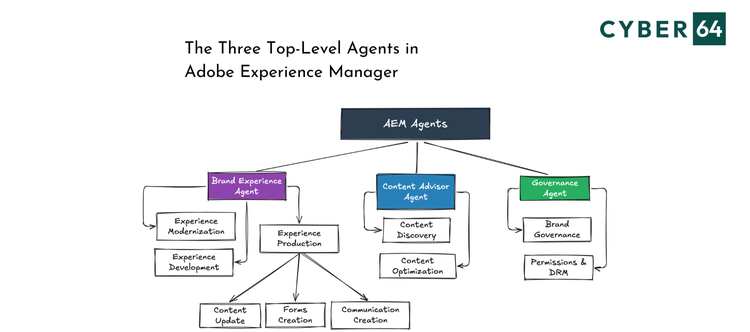
AEM as a Cloud Service now ships with three top-level AI agents: the Brand Experience Agent, the Content Advisor Agent, and the Governance Agent. Each contains specialized sub-agents or jobs targeting different parts of the content lifecycle.
Brand Experience Agent
Content Advisor Agent
Governance Agent
Access and Availability
This is not the same as the AI Assistant that has been in AEM for a while.
- The AI Assistant answers questions.
- These agents perform work. They modify content, create forms, troubleshoot pipelines, validate brand compliance, and migrate sites, autonomously, with human review.
This article maps the full AEM agent taxonomy, what each agent does, how to access them, and how they connect to the broader Adobe agent ecosystem.
Brand Experience Agent
The Brand Experience Agent is the operational core. It absorbs the high-effort, high-volume work behind content updates, site transformation, and technical troubleshooting. Three sub-agents sit underneath it.
1. Experience Modernization Agent
Key Purpose: Migrate websites to Edge Delivery Services with AEM authoring.
This is the agent that removes the biggest barrier to EDS adoption, which is the migration itself. It combines two skill sets:
- Site creation and migration. Takes an existing site and transforms it into the EDS block-based architecture. Handles structure mapping, content migration, and initial block setup.
- Block development. Creates new blocks, refines templates, applies style updates, and builds landing pages for ongoing site evolution after migration.
How to access it: Through the Experience Modernization Console at aemcoder.adobe.io. It is a hosted, web-based AI development environment. Connect your GitHub project and prompt changes in natural language. No local development environment required.
The agent understands your project by reading three inputs: your project documentation, the Git repository, and the AEM content model. It constructs a working model of how the site operates before proposing changes.
2. Experience Production Agent
Key Purpose: Automate content production across three job types.
a) Content Update Job
Modifies existing content, including content fragments, pages, forms, and assets, using natural language instructions. It can also process inputs from Jira PDFs and screenshots.
This is the agent equivalent of what MCP does through explicit tool calls. With MCP, you describe the change and the LLM constructs the API calls. With the Content Update Job, the agent handles the entire workflow end-to-end, including determining which content to modify and how.
Works on both AEM as a Cloud Service and Edge Delivery Services content.
b) Forms Creation Job
Transforms natural language requirements into structured, branded adaptive forms. Describe the form you need, the fields, the validation rules, the layout, and the agent creates it. No developer involvement required.
It can also import existing forms and adapt them to match enterprise brand and governance guidelines automatically.
c) Communication Creation Job
Generates personalized, data-driven correspondence at scale. Account statements, policy documents, bills, welcome kits, and similar communications. The agent takes natural language requirements and produces professional communications that can be delivered through AEM's output channels.
This targets the document output use case that AEM Forms has traditionally served, now accessible through natural language instead of template configuration.
3. Experience Development Agent
Key purpose: Assist developers with code creation, debugging, deployment, and optimization.
The most immediately useful capability is pipeline troubleshooting. When a Cloud Manager pipeline fails, the Development Agent performs root cause analysis and provides remediation guidance. It supports:
- Build & Unit Testing step. Analyzes build failures, identifies the failing module, and suggests fixes.
- Code Scanning step. Reviews code quality violations, security vulnerabilities, and quality gate failures. Provides specific remediation guidance for each issue.
Access the Development Agent through the AI Assistant in Cloud Manager or Experience Hub.
Content Advisor Agent
The Content Advisor Agent focuses on asset discovery and optimization. Two jobs.
Content Discovery Job
Searches across AEM to find relevant, approved content for reuse. It interprets user intent, not just keywords, and surfaces matching assets including images, videos, PDFs, articles, content fragments, adaptive forms, and templates.
This solves the "I know we have this asset somewhere" problem that every content team faces as their DAM grows. Instead of browsing folder structures or guessing metadata keywords, you describe what you need and the agent finds it.
Content Optimization Job
Adapts visuals, images, and videos for specific channels. Generates rendition variations, adjusts backgrounds, applies channel-specific formatting, and prepares assets for deployment across different touchpoints.
The goal is to take a single source asset and produce channel-ready variations without manual design work for each output.
Governance Agent
The Governance Agent is the compliance and brand integrity layer. It operates differently from the other two agents. Instead of creating or modifying content, it validates and enforces standards.
Brand Governance
Validates content against established brand standards. It analyzes:
- Tone and voice. Does the content match brand communication guidelines?
- Claims. Are product or service claims accurate and approved?
- Logo usage. Does logo placement follow brand guidelines?
- Typography. Are the correct fonts and type treatments applied?
- Imagery. Do images align with brand visual standards?
The Governance Agent operates across multiple interfaces: chat, editors, and batch processing. This makes it useful for validating AI-generated content, reviewing site migrations, and auditing existing content at scale.
Permissions and Digital Rights Management
Two capabilities:
- Content Hub integration. Uses attribute-based access controls to restrict asset availability to appropriate users. This prevents compliance issues from assets being used in unauthorized contexts.
- Assets DRM. Manages usage rights and expiration dates at a granular level. Tracks which assets have active licenses, which are approaching expiration, and which have usage restrictions.
A2A and MCP Integration
The Governance Agent integrates via both Agent-to-Agent (A2A) protocol and MCP (Model Context Protocol). This means it can be invoked by external AI tools, including ChatGPT and Claude, not just Adobe's own interfaces.
This is architecturally significant. It means you can build workflows where an external AI creates content and the Governance Agent validates it against your brand standards before publication, all through standard protocols.
How AEM Agents Connect to the Broader Ecosystem
Three layers:
MCP (Model Context Protocol) is the tool layer. The AEM Content MCP server exposes 60+ operations (search, create, patch, publish). These are the individual actions. Any MCP-compatible client can invoke them.
AEM Agents are the automation layer. They combine multiple operations into workflows. The Content Update Job does not just patch a fragment. It reads the content, understands the intent, determines the changes, applies them, and validates the result. It uses the same underlying AEM APIs that MCP exposes, but orchestrates them autonomously.
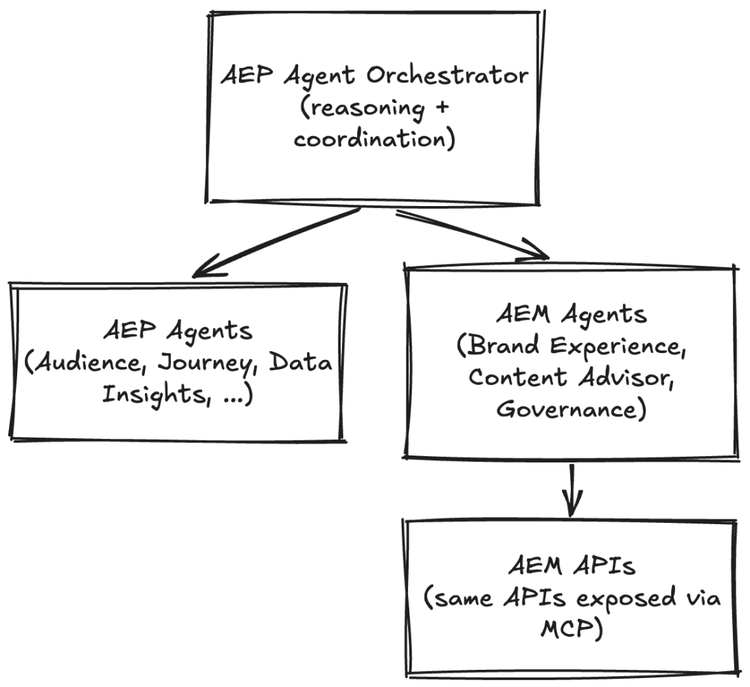
AEP Agent Orchestrator is the reasoning layer. It sits above both AEM agents and AEP agents (Audience, Journey, Data Insights), coordinating cross-product workflows. A campaign workflow might involve the Audience Agent defining the target segment, the Content Update Job adapting content for that segment, the Governance Agent validating compliance, and the Journey Agent orchestrating delivery
Access and Availability
AEM agents are available on AEM as a Cloud Service and Edge Delivery Services only. Not available on AEM 6.5, on-premise, or Managed Services.
Three ways to access:
- AEM Playground. Experimentation and evaluation. No commitment required.
- "Try Before You Buy" program. Phased rollout through your CSM or TAM. Lets you evaluate agents in your own environment before licensing.
- Agentic SKU. The production license. Discuss with your Customer Success Manager or Technical Account Manager.
Adobe's standard caveat applies: AI-generated responses may be inaccurate or misleading. Human review is expected for all agent outputs.
What This Means for Teams
For content teams
The Brand Experience Agent's production jobs (Content Update, Forms, Communications) reduce the manual effort behind bulk content changes. The Content Advisor Agent eliminates the asset discovery bottleneck. Combined, these agents compress the content production cycle from days to hours for high-volume operations.
For developers
The Experience Development Agent's pipeline troubleshooting is immediately useful. The Experience Modernization Agent changes the EDS migration equation, what previously required deep EDS expertise can now be bootstrapped through the hosted console. Developers shift from writing boilerplate to reviewing and refining agent output.
For governance and compliance teams
The Governance Agent provides automated brand and compliance validation at a scale that manual review cannot match. Its A2A and MCP integration means it can be embedded into any content workflow, not just Adobe's own interfaces.
For Adobe partners
The full agent taxonomy (Brand Experience, Content Advisor, Governance) is the new foundation for AEM service delivery. Understanding what each agent does, what it does not do, and how to configure it for client environments is becoming essential knowledge. Partners who can demonstrate agent-augmented workflows will differentiate themselves in proposals and implementations.