AI and the Future of Adobe Workfront
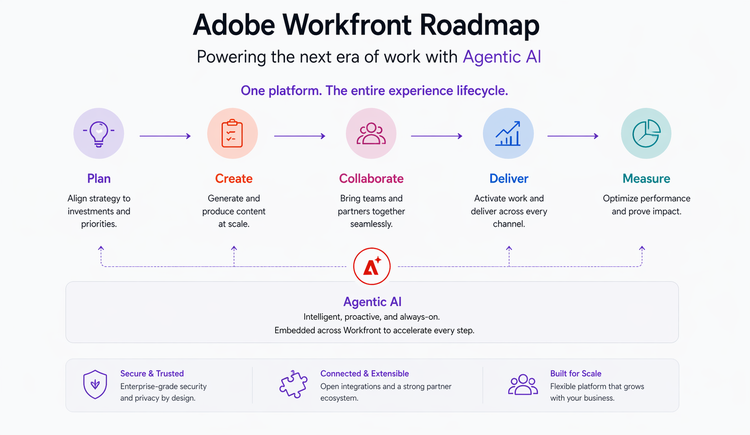
At Adobe Summit 2026, session OS807 covered shifts in AI and the Adobe Workfront roadmap, presented by Lauren Sisneros, Product Marketing Manager on the Adobe Workfront team. Agentic AI is a seismic technological shift, and it is changing how we work across the entire digital ecosystem and the entire experience lifecycle.
The areas where those changes are showing up include:
- Content creation
- Ideation and planning
- Journey orchestration
- Audience management
- Insight generation
- Information synthesis
- Asset production
AI is not only being infused at an individual level — it is being infused in workflows.
Adobe Workfront Context
The Adobe Workfront Roadmap
Connecting the Content Supply Chain
Adobe Workfront Context
Adobe GenStudio is the connected system for the Agentic Content Supply Chain. As a solution, it is a suite of products that Adobe has built to solve the content supply chain challenge across humans, agents, workflows, context, and brand.
Adobe Workfront is the coordination and context layer for GenStudio.
The Adobe Workfront Roadmap
AI Innovation
The campaign lifecycle starts earlier than most people think. Ideation is where great campaigns begin, and good campaigns are optimized. Ideation ensures that campaign strategy is driven by insight rather than instinct, and ideation and planning are cyclical.
To serve that part of the lifecycle, the session introduced Project Catalyze — Adobe’s strategic ideation canvas. It provides a dedicated infinite-canvas UI where teams synthesize inputs, context, and performance to shape campaign strategy.
Project Catalyze is backed by Adobe’s Strategic Ideation Agent. Catalyze synthesizes data from Customer Journey Analytics alongside user files and prompts for a robust, data-driven strategy. That strategy can then be moved into Workfront Planning for delivery and management of those plans. Project Catalyze will be included in Workfront Planning, and anyone using Workfront Planning will be able to activate it as soon as it becomes generally available.
AI Accelerators for delivery
AI Collaborators are introduced for seamless human-plus-agent collaboration at enterprise scale. The idea is to enhance existing workflows by assigning tasks to AI agents for speed and scale. Existing AI agents can now be directly included in marketing workflows, where they can be assigned to execute a task, resolve an issue, or perform a review — while pulling data and context directly from the Workfront project.
AI Collaborators can connect to Adobe agents, meaning existing Adobe agents can be invoked directly within workflows. Third-party agents — including Microsoft Copilot Studio, Claude Code, and similar — can also be brought into existing workflows.
AI-driven workflow optimization
The Workflow Optimization Agent streamlines marketing and creative workflows by translating natural language into intelligent, connected actions across planning, execution, review and approval, and insights.
Using the agent, users describe what they need, and the Workflow Optimization Agent can act for them. The jobs it performs span different areas of the product:
- Planning — using AI intelligence to set up workspaces
- Workflow — smart project creation using chat-based prompts
- Content review acceleration — prompting the agent to set up multi-stage approvals
- Instant insights — into the status of a project and the resources available on projects
Importantly, AI interaction is multi-modal. It can be accessed in full-screen mode, via the AI assistant in the right rail, or natively embedded in the product.
Connecting the Content Supply Chain
Metadata is the connective tissue of the content supply chain. Without it, assets are orphaned, campaigns lose context, and AI has nothing meaningful to act on.
Building a metadata foundation
Workfront Planning is the central hub where teams can turn strategy into results. The idea is to store all campaign plans, goals, and KPIs in a connected graph of data. In this way, campaign context is stored for both people and AI, making both more effective — better visibility, coordinated campaigns, and improved cross-team alignment.
Global record types, intended to give even more ability to standardize metadata, were recently launched. They help ensure that every system speaks the same language.
Later this year, Workfront Planning will be available as a standalone product. Currently, it is available only together with Workfront Workflow. The standalone option will give teams the ability to combine the simplicity of spreadsheets with the power of enterprise software.
Delivering the keys to creative work-in-progress
By recently launching Unified Review & Approval, Adobe brought together two best-in-class products — Adobe Workfront and Frame.io — to power a single experience that centralizes creative work in progress and accelerates delivery. The idea was to bring in Frame.io for the review experience and close the gaps between marketing management, creative review, and content delivery.
Taking it one step further, disconnected storage often leads to disconnected workflows. Adobe introduced unified storage across three suites of products: Workfront, Frame.io, and Creative Cloud tools now share a single storage layer, powered by the Adobe Cloud Platform.
In addition, all of the shared files across these products will be accessible directly from the desktop via Mounted Drive, introduced later this year. Together, this enables a seamless creative work-in-progress process.
Picture perfect content for every campaign
Adobe Experience Manager Content Advisor is introduced within Adobe Workfront. Customers will be able to discover assets based on their Workfront project, campaign data, or data within Workfront Planning. This reduces the time spent searching for assets and improves content consistency and reuse across channels.
A connected ecosystem for delivery
In the second half of this year, Adobe is planning to introduce the ability to connect Workfront workflow instances to enable a brand-to-agency connection. This will enable shared requests, connected workflows, and accelerated delivery.