Can This Data Be Used Right Now? Closing the Governed Data Gap in Adobe Experience Platform
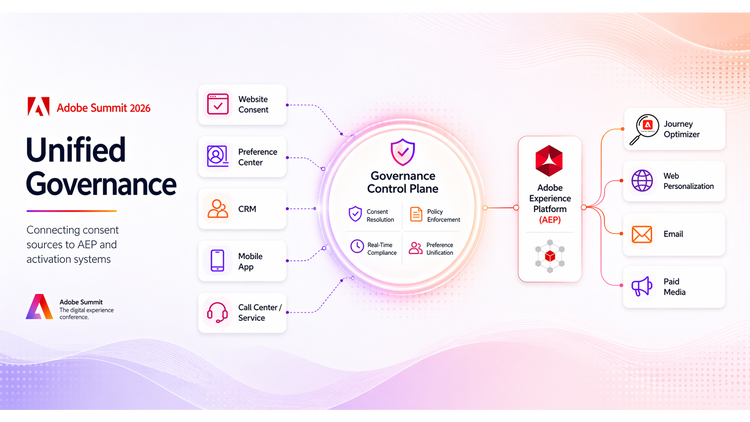
Enterprises investing in Adobe Experience Platform and Adobe Journey Optimizer expect AI-driven growth. A meaningful share of them are not getting it. The usual first instinct is to blame the technology or the data. At Adobe Summit 2026, the session on unified governance pushed back on that instinct. The issue is rarely the platform. It is fragmented consent and preference signals spread across systems that were never designed to agree with each other.
That fragmentation creates what the session called a governed data gap. It is not a tooling problem. It is a coordination problem, and it quietly taxes every AI and orchestration investment sitting on top of it.
This article covers the specific failure mode the governed data gap creates, how a real-time compliance layer closes it, how the integration into Adobe Experience Platform actually works, and what changes for teams once it is in place.
The Problem: Fragmented Consent, Limited Activation
The Diagnosis: A Governed Data Gap
The Solution: A Real-Time Compliance Layer
How It Works
A Fortune 20 Retailer in Practice
The Problem: Fragmented Consent, Limited Activation
Most organizations operate with multiple systems that each track their own version of customer permissions. Consent banners on the website. Preference centers inside account portals. CRMs holding sales-managed opt-ins. CDPs holding marketing-managed audiences. Data warehouses holding analytics and downstream processing. Each of these systems maintains its own view of what a given customer has agreed to and when.
Two failure modes follow from this, and they are the ones that actually stall AI initiatives:
- AI models may train on data that is out of compliance. The signal reaches the model, but the consent that authorized its use was withdrawn or narrowed somewhere else in the stack, and the model never finds out.
- Addressable audiences shrink due to uncertainty around data usability. When no one can confidently answer whether a given segment is usable, the safe default is to exclude anything ambiguous. Segments that would have been compliant get dropped along with the ones that were not.
The question teams increasingly cannot answer is blunt: Can this data be used right now? Not last quarter. Not on average. Right now, for this specific activation. If that answer takes a meeting to produce, the platform is already losing audience to uncertainty.
The Diagnosis: A Governed Data Gap
The session’s framing was useful precisely because it was not another tooling story. The governed data gap is what opens up when consent and preference signals live in multiple systems that disagree with each other, and when reconciling those disagreements is a manual, point-in-time process instead of a live enforcement mechanism.
Every organization with a modern stack has some version of this gap. The ones that have solved it have done so not by picking a “best” consent system, but by moving consent enforcement out of the individual systems and into a single real-time layer that all of them feed from.
The Solution: A Real-Time Compliance Layer
Transcend, the partner featured in the session, operates as a centralized compliance control plane rather than a consent repository. The distinction matters. A repository is a place where consent is stored. A control plane is a place where consent is enforced, at the moment an activation decision is being made, in every system that participates.
Rather than treating consent as a static checkbox that was true at sign-up, the control plane enforces permissions directly where data lives. All consent and preference updates flow into Transcend first. From there, changes propagate in real time to every connected system. That creates a single enforced source of truth across the data ecosystem, which is what makes the fundamental question answerable again.
How It Works
Unified Identity Resolution
The control plane consolidates multiple identifiers — emails, membership IDs, device IDs, and CDP profiles — into a single canonical consent record per individual. This is the part that quietly does the heavy lifting. Without unified identity, the same person appears as several “different” profiles, and reconciling their preferences becomes guesswork.
Deep AEP Integration
Consent signals map directly into Adobe’s XDM schemas, which is what makes every downstream campaign and journey able to operate on governed data natively rather than through a separate check step. The integration supports three patterns, each for a different operational need:
- Batch ingestion for initial synchronization — getting the existing state of the world into Transcend once.
- Real-time streaming for immediate updates — so a preference change in the front end is reflected in AEP activation within seconds, not overnight.
- Bidirectional syncing so that changes made inside Adobe tools propagate system-wide instead of staying local to AEP.
Policy Enforcement at Scale
Organizations encode complex rules inside the control plane itself: regional compliance requirements, channel-specific permissions, and legal constraints that may apply to some segments but not others. Every activation decision is evaluated against these rules before it leaves the platform, so policy compliance is part of the execution path rather than a downstream review step that catches violations after the fact.
A Fortune 20 Retailer in Practice
The session grounded the pattern in a real example. A Fortune 20 retailer building a large-scale retail media network needed every activation decision backed by consistent, real-time consent. At that scale, even minor discrepancies across systems carry meaningful compliance risk and direct revenue impact — a retail media network lives or dies on the precision of its audience claims.
By centralizing consent enforcement, three things happened:
- Audience sizes increased. Teams could activate with higher confidence, which meant fewer audiences were being precautionarily trimmed to avoid compliance ambiguity.
- AI initiatives moved faster. Legal reviews that used to gate every new model or segment became exception-based rather than default, because the platform was already enforcing policy in-line.
- Compliance shifted from a constraint to an operational enabler. Instead of a function that slowed things down, governance became the reason the team could move quickly without exposure.
That last shift is the one worth naming explicitly. It is the difference between compliance as a checkpoint and compliance as infrastructure.
What This Means for Teams
For marketing and activation leaders
If addressable audience size has been flat or shrinking despite more data being collected, the likely cause is precautionary exclusion rather than a true data shortage. A unified, real-time consent layer typically grows usable audiences without acquiring a single new record, because existing records become activatable with confidence.
For data and AI teams
Training on out-of-compliance data is not a theoretical risk. Without a control plane enforcing permissions at the moment of use, models inevitably pull signals whose consent status has changed since ingestion. Move consent enforcement upstream of the training and activation paths, not alongside them.
For legal, privacy, and compliance teams
The change is about operating model more than about tooling. When policy is encoded in the control plane and enforced automatically, the function moves from reviewing individual activations to designing and updating the rule set. That is a higher-leverage role, and it stops being a bottleneck on marketing and product velocity.
For Adobe partners
The governed data gap is common, but organizations rarely diagnose it as a governance problem. They usually describe it as “AI not delivering ROI” or “audience sizes keep shrinking.” Partners who can translate those symptoms into the right diagnosis, and propose a real-time compliance layer as part of the AEP implementation rather than after it, will be solving a problem clients did not know to scope.
For architects
Treat consent as a first-class integration, not as a per-system feature. Design the stack so that consent state is maintained in one place and enforced everywhere, and so that adding a new downstream system is a connector exercise, not a rewiring of the governance model.
The takeaway
The governed data gap is not a tooling issue. It is a coordination problem, and solving it unlocks the value of every other investment sitting on top of Adobe Experience Platform. With a single governed consent record powering every audience and journey, enterprises can finally align AI capability with compliant data usage — and activate at scale with confidence rather than caution.