CDP 101: What it is, what it isn’t, and how it stacks up

TL;DR: A Customer Data Platform (CDP) is packaged software that unifies all your customer data, both known and anonymous, into persistent, privacy-aware profiles you can actually use across channels in real or near real time. It doesn’t replace CRM, data warehouse, DMP, or marketing automation, it sits alongside them, making each one smarter and more coordinated.
What a CDP actually is
CDP vs the rest of your (Mar)Tech stack
Two architectural paths
When a CDP makes sense?
How to evaluate (a fast, practical rubric)
Conclusion
What a CDP actually is
A CDP is purpose-built to collect first-party data from many sources (web, apps, ecommerce, CRM, support, offline), unify it into durable, person-level profiles (including identity resolution across devices), and activate it to your channels and partners, consistently and compliantly. Think of it as the connective tissue that turns interactions into one living customer record that marketing can use without filing an IT ticket. That’s the essence of the CDP Institute’s definition: a packaged system that creates a persistent, unified customer database that’s accessible to other systems.
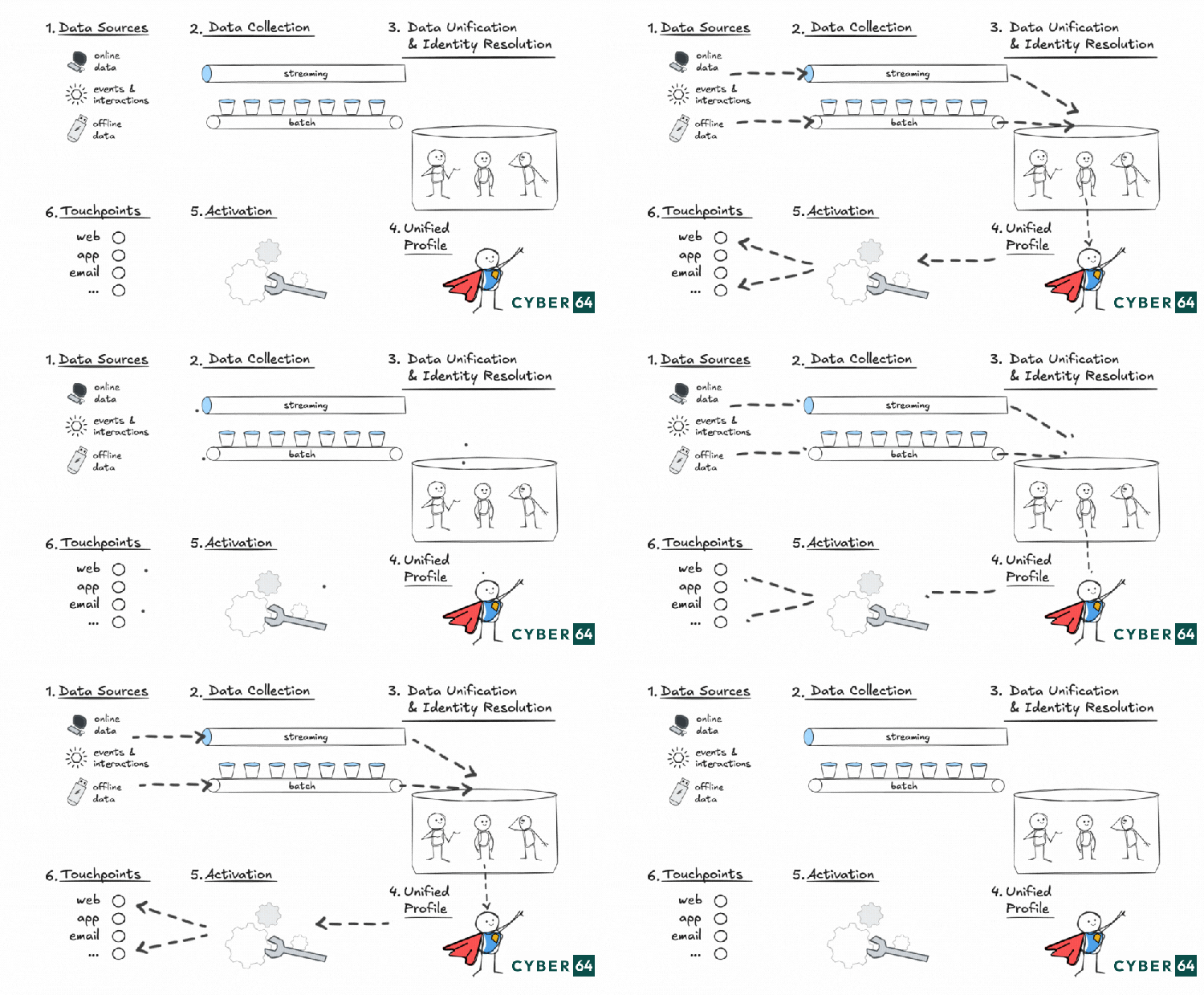
Some of the leading platforms illustrate this well. For example:
- Adobe Real-Time CDP focuses on unifying known + anonymous data and activating it across channels
- Tealium highlights real-time identity stitching and audience orchestration
- Treasure Data emphasizes enterprise-scale unification and activation.
CDP vs the rest of your (Mar)Tech stack
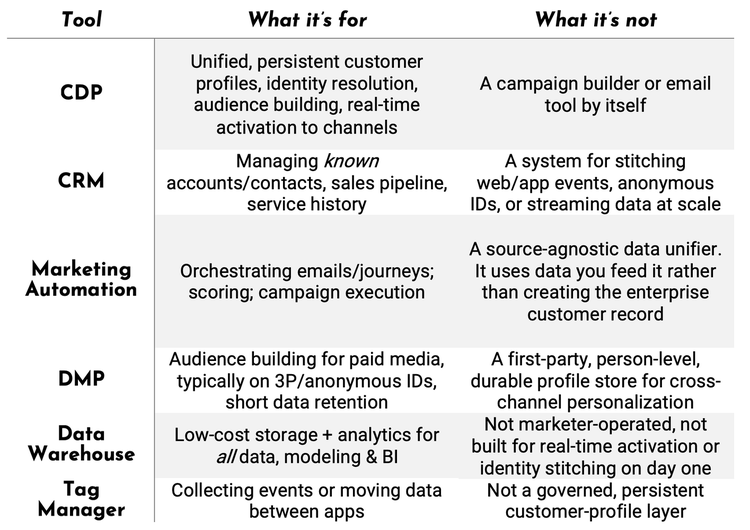
CDP plays quarterback, not by sending emails or replacing sales systems, but by feeding every tool the same trusted profile and segment logic, so journeys stay consistent everywhere. All leading CDP vendors stress that “unify → govern → activate” loop for exactly this
Two architectural paths
Packaged (traditional) CDP
With packaged CDP you buy a vendor solution that brings ingestion, identity, profiles, segmentation, governance, and activation in one product. This means fast time-to-value, marketer-friendly, fewer moving parts. This is the model behind suites like Adobe RTCDP, Tealium, and Treasure Data.
Composable CDP
Rather than keeping a separate CDP database, you build profiles directly in your existing cloud data warehouse (like Snowflake, BigQuery, Databricks) and assemble best-of-breed components (event collection, identity, reverse ETL activation) on top. CDP Institute defines “composable CDP” as warehouse-native profiles accessed by modular tools. This is a solid alternative when you want tighter control, less data duplication, and to leverage your data platform investments.
Which path is right for you?
The rule of thumb in this case would be:
- If you need a quick, marketer-owned starting point, answer is usally packaged CDP.
- If you already have a mature data engineering practice and a robust warehouse strategy, go with composable can make sense.
From what I have seen, many enterprises end up with hybrid setup. This means using packaged CDP for real-time identity & activation while leaning on the warehouse for deep analytics.
Top three capabilities to insist on (regardless of vendor, architecture or approach)
- True identity resolution across anonymous and known signals (like web/app events, CRM, offline) with combination of transparent rules you can govern. (Good example is Tealium’s “visitor stitching”.)
- Real-time profile updates and activation so your personalisation windows (like browse-to-buy, churn rescue, cart save) aren’t missed. (See how Adobe Real-Time CDP’s puts emphasis on real-time profiles and destinations.)
- Governance with consent controls baked in the platform. Always assure the first-party data is usable and compliant across destinations, not copied around in ad-hoc ways. (All relevant vendors increasingly position governance as a core pillar.)
When a CDP makes sense?
A CDP implementation is usually a significant financial and technological investment. It's often not just a project but a full initiative. Here are some good indicators of when organizations should opt for a CDP:
- You’re juggling multiple channels/brands/markets and need one definition of “customer” and “audience” everywhere.
- Your marketing automation and CRM tools are powerful, but segmentation logic lives in silos isolated in different tools, leading to inconsistent customer journeys.
- You’re preparing for a cookieless, consent-first world and want to maximize the value of first-party data across owned and paid touchpoints.
How to evaluate (a fast, practical rubric)
1. Start with use cases, not features
Entire MarTech, but especially CDP selection, should be based on target use cases. Define use cases, and everything else will become clear. IT will help you to decide which data in which frequency is required and what are the tool capabilities you are searching for.
2. Ask for proof of speed to value.
CDP implementation can be long, exhausting for entire organization and without any valuable outcomes on the horizon. Always evaluate how quickly can you get your top data sources ingested, IDs stitched, and push audiences to primary channels?
3. Inspect governance.
Verify if you can use the solution to express consent and data-use policies once and have them enforced across destinations.
4. Check real-time reality
Analyze what’s the actual SLA from event to profile tp activation for your top priority use cases?
5. Plan the coexistence
Ask where the rest of your MarTech stack like CRM, marketing automation, DWH, and (if you still use one :)) DMP fit once the CDP is live?

Conclusion
A CDP isn’t just “another database”.
It’s the operational customer brain that turns your first-party data into orchestrated, privacy-aware action.
Whether you choose a packaged platform or a composable, warehouse driven approach, the goal is always the same:
- one trusted profile
- governed once
- activated everywhere your customers engage