Data Collaboration in Today’s Customer Experience Landscape
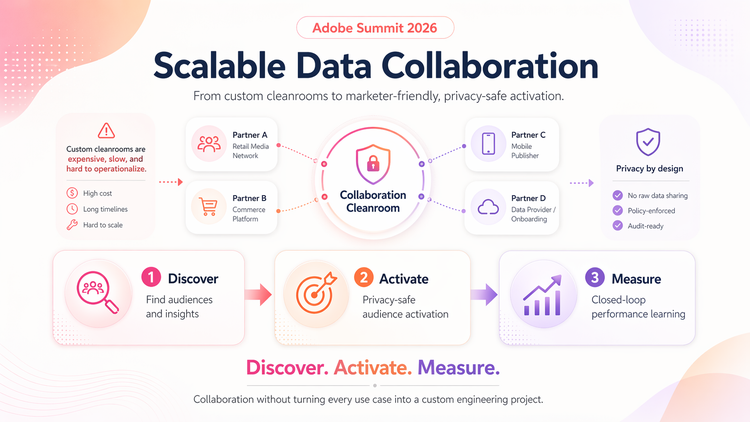
Developing custom data cleanrooms for clients is hard. They are expensive, slow to evolve, and difficult to operationalize — and yet data collaboration is exactly where modern marketing growth now lives. The question the session tackled is how to make collaboration scalable, marketer-friendly, and privacy-safe, without turning every use case into a custom engineering project.
Why it is harder than ever to measure the impact of new audiences
New strategies and ways of working for brands
Why scaling data collaboration is still a challenge
Adobe Real-Time CDP Collaboration
Why use Adobe’s data cleanroom solution?
Business impact
Why it is harder than ever to measure the impact of new audiences
Measuring the impact of new audiences is harder than ever because of signal loss. Cookies are imprecise, most browsers do not support them, and consumers are opting out. The result: over 70% of the internet is not reachable. On top of that, data privacy concerns are growing, and the complexity of the technology that powers marketing keeps increasing — multiple systems, disparate data sources, and more to manage and maintain.
New strategies and ways of working for brands
Despite those challenges, advertisers have adapted by leaning into a few new ways of working:
- First-party data activation from their own CDPs — 78% of companies.
- Second-party data through collaboration with publishers and other brands — 51% of agencies and 42% of brands use or plan to use it.
- New channels like connected TV and media networks — 60% or more of marketers are actively investing.
Why scaling data collaboration is still a challenge
Even with that shift, scaling data collaboration remains a challenge. Four specific problems keep showing up:
- Disconnected from the overall strategy. Data cleanrooms live outside the core marketing strategy and become side projects rather than part of how teams plan, activate, and measure.
- Slow and complex to use for marketing. The tools are too technical for marketing teams.
- Limited interoperability. Most cleanrooms are optimized for one ecosystem and do not work well across different platforms or clouds.
- Adds to data privacy concerns. The way data has to move to make cleanrooms work often increases privacy risk and slows everything down.
Adobe Real-Time CDP Collaboration
Collaboration is designed as a continuous loop rather than a series of one-off projects. It covers three steps:
- Discover — get key insights about the audiences you might use.
- Activate — activate audiences to your publisher partner, back to your CDP, or to a CSV or public cloud storage, by defining the frequency and date of activation.
- Measure — in-flight, marketer-friendly measurement, including reports on targeting, return on ad spend, and conversion events over time.
Collaboration is built directly into the Adobe Experience Platform foundation, so insights can quickly be turned into action.
As a brand, you can easily connect with publishers, retail media networks, or other marketers to deepen insights and improve performance.
As a publisher, you are instantly discoverable to Adobe’s global customer base through a privacy-centric workflow, so advertisers can work with you in minutes. One shared environment, endless use cases.
Why use Adobe’s data cleanroom solution?
- Already integrated in AEP. No custom-built, one-time project effort.
- Connectivity to all the same customer data.
- Designed for marketers — only a few clicks to get first insights. No custom SQL queries for every question and use case.
- Zero data movement. Agnostic to all cloud providers.
- Privacy is not a time sink. Time is not spent evaluating whether privacy is a risk. Underlying customer data is protected.
Business impact
Outcomes from real brands using Collaboration at scale:
- 30% conversion lift — greater conversions.
- 25% increase in site traffic — qualified traffic.
- 3-week reduction in onboarding — faster time to market.
- 90% performance lift — better performance overall.
Conclusion
Not more data, but better collaboration, is the key to using the data that lives outside the brand’s walls — with privacy first in mind.