Deliver Connected Experiences with Adobe Experience Platform
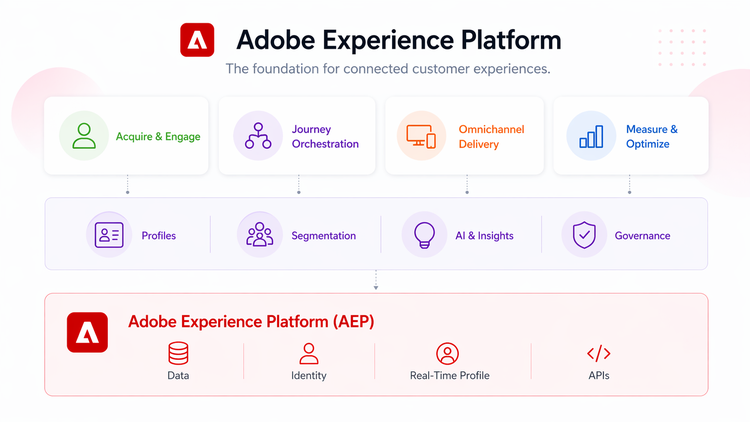
At Adobe Summit 2026, one of the platform-level sessions focused on how Adobe Experience Platform breaks down the technical complexity of delivering connected customer experiences — bringing together data, insights, orchestration, and omnichannel delivery so that teams and organizations can act as one. The session walked through why AEP is needed, what it solves, how it solves it, and the capabilities and landscape that sit on top of it.
Why Adobe Experience Platform?
Key issues and what it solves
How does it solve them?
Capabilities of AEP
AEP landscape and capabilities
Why Adobe Experience Platform?
Personalization is no longer a nice-to-have. It is non-negotiable for 71% of customers, with up to 40% more revenue potential when it is delivered well. Meeting that expectation at scale is what AEP is designed for: delivering more connected and consistent customer experiences across every moment of engagement.
Key issues and what it solves
Being unable to deliver unified customer experiences means missing out on more than just a moment. The impact shows up across three layers:
Business outcomes:
- Opportunity
- Market share
- Revenue
Operational side of the business:
- Organizational efficiency
- Customer insights
Long-term ramifications:
- Brand reputation
- Customer trust
Underneath those outcomes are the traditional channel-marketing bottlenecks that keep reappearing:
- Disparate platforms, teams, and processes.
- Channel-specific content requirements.
- Data
- Governance
- Real-time delivery
How does it solve them?
Adobe Experience Platform unifies data at the core by providing minimal data movement, a common edge, a pipeline for real-time use cases, and identity resolution — creating a single unified profile.
That unification enables:
- Centralized segmentation
- Privacy and governance.
- A flexible foundation for upcoming needs — AI, agents, and identity resolution after new data sources are added
AEP foundation capabilities are shared across different workflows:
- Core
- CX
- Marketing
Capabilities of AEP
- Data collection and ingestion from different sources with minimal data movement.
- Data unification — a single real-time semantic customer profile that supports both B2C and B2B use cases.
- Activation and orchestration workflows to create, manage, fine-tune, and enrich audiences, and to activate one-to-one trigger-based journeys based on logic, customer attributes, and behavioral events that fuel decisioning.
- Governance and privacy — built-in tools for compliance and customer preferences.
- Performance analysis and insights — native reporting, AI-driven segmentation, ROI-based analytics, and more, for acting on customer experiences in the moment.
- Agentic and generative AI — generate content, build audiences, and analyze performance instantly.
- Extensibility — APIs and integrations that extend capability across teams, systems, and use cases.
AEP landscape and capabilities
Adobe Experience Platform is an intelligent, connected platform that encompasses a wide range of capabilities:
- Adobe Mix Modeler — AI-driven impact measurement of advertising and marketing.
- Adobe Real-Time CDP Collaboration — discover audiences, activate via channels, and engage in outcome-based campaign management.
- Adobe Customer Journey Analytics — ingest, connect, and standardize data (online and offline) for instant non-destructive analysis.
- Adobe Journey Optimizer — customer journey orchestration, decisioning, and delivery to relevant customers across channels.
- Adobe Real-Time CDP — harmonize data to activate B2B and B2C real-time unified profiles and audiences.
- Content Analytics — visualize and act on content performance and engagement tied to journey and revenue.
Experience Platform Agent Orchestrator
Agent Orchestrator includes the following capabilities:
- Purpose-built Agents
- Multi-Agent collaboration
- Reasoning Engine
- Customer Experience Models Engine
- AI Assistant
Adobe applications that extend the capabilities
- Adobe Target
- Adobe Experience Manager
- Adobe Audience Manager
- Adobe Campaign
- Adobe Workfront
- Adobe Commerce
- Adobe Analytics
- Adobe Marketo Engage
- Adobe Concierge
- GenStudio for Performance Marketing