Designing Connected Commerce Journeys: Why Execution Fails in the Decisions Nobody Sees
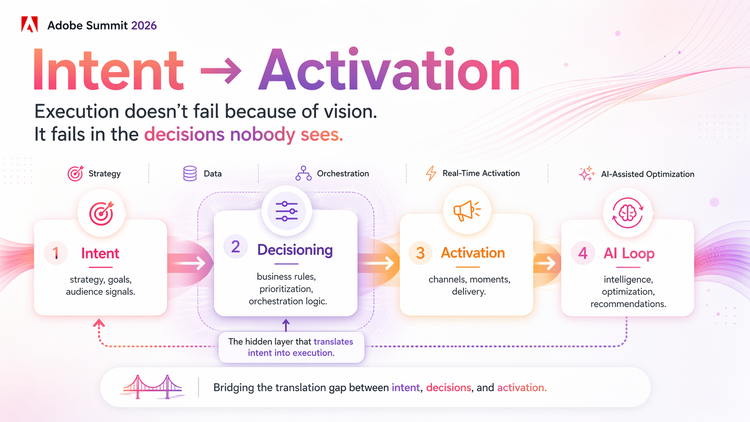
At Adobe Summit 2026, one of the most direct commerce sessions of the week was built around a single diagnosis: most organizations already know what a connected journey should look like. They have the strategy decks. They have the tooling. What they do not have is a consistent way to translate that intent into execution across systems, teams, and moments.
This is not a tooling problem. It is a decision problem. Platforms do not fix fragmented journeys. They expose them.
This article covers the translation gap between intent and activation, the four layers teams need to align, when real-time activation beats orchestration (and when it does not), and what changes when AI enters the loop.
The Translation Gap
The Framework: From Intent to Activation
Two Activation Patterns, Not One
Same Intent Does Not Mean Same Strategy
Three Principles That Scale
Why AI Does Not Remove the Complexity
The Translation Gap
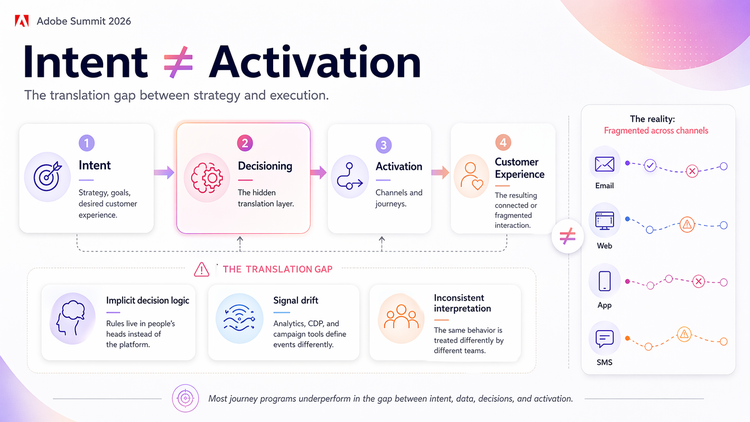
The aim is seamless, connected experiences. The reality, for most customers, is fragmented interactions across channels. That is not because strategy is wrong. It is because the decision logic is unclear, the data signals are inconsistent, and teams interpret customer behavior differently.
Three gaps show up repeatedly:
- Decision logic is implicit, held in the heads of individual PMs and marketers rather than documented as rules the platform can enforce.
- Signals and data definitions drift between teams. The same event means different things in analytics, CDP, and campaign tools.
- Behavior gets interpreted inconsistently. A cart abandon looks like one problem, but in practice it is three or four, and teams treat them as one.
This is the translation gap. It is where most journey programs quietly underperform, regardless of the logo on the platform.
The Framework: From Intent to Activation
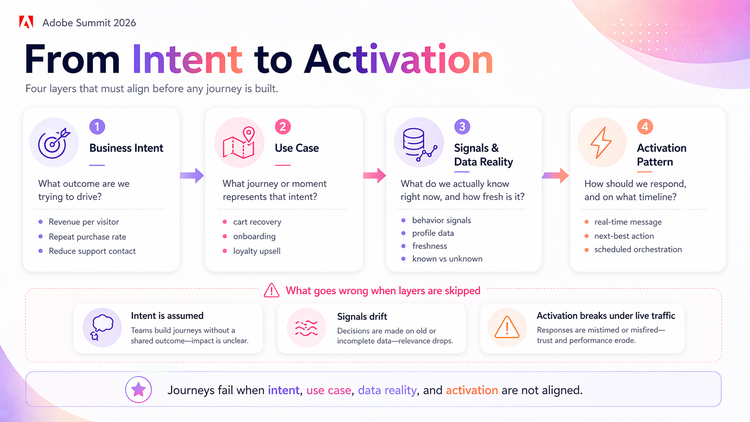
To move from intent to activation, the session laid out four layers that need to line up before any journey is built:
- Business intent. What outcome are we actually trying to drive? Revenue per visitor? Repeat purchase rate? Reducing support contact in-journey?
- Use case definition. What journey or moment represents that intent in the customer’s world?
- Signals and data reality. What do we actually know about this customer right now, and how fresh is it?
- Activation pattern. How should we respond, and on what timeline?
When any of these layers is skipped or assumed, teams end up building journeys that look good in a diagram and break the moment they meet live traffic.
Two Activation Patterns, Not One
The most overlooked decision in journey design is not what to do. It is when to act. There are two fundamentally different patterns, and they are not interchangeable.
In-Session Activation (Commerce-Led)
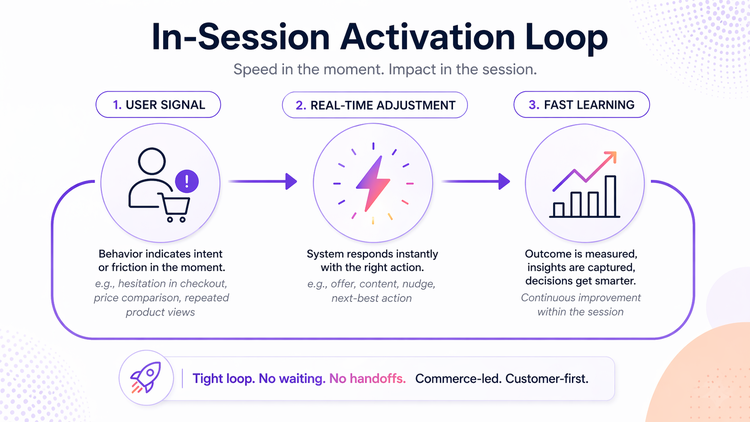
In-session activation wins when immediacy matters. The user is hesitating in checkout. They are comparing products. They are showing clear friction. In those moments, speed beats complexity. A real-time adjustment inside the session, based on a behavioral signal, will outperform any orchestrated follow-up.
The loop is tight: user signal → real-time adjustment → fast learning. No downstream waiting. No cross-channel coordination. Commerce-led.
Post-Session Orchestration (Journey-Led)
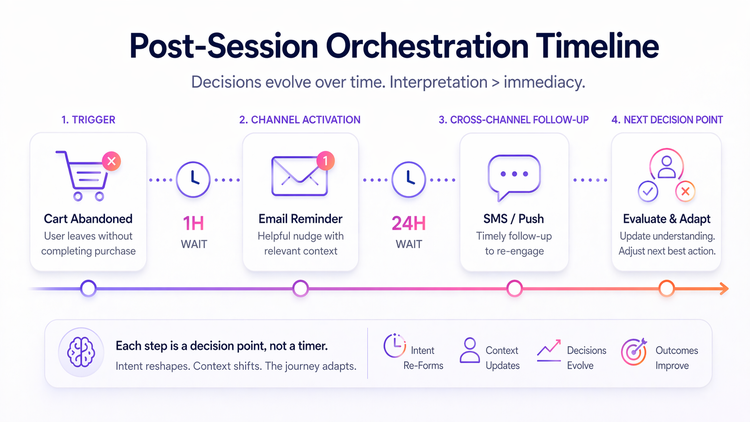
Post-session orchestration wins when the decision evolves over time. High-consideration purchases. Lifecycle engagement. Cross-channel nurture that depends on recent history. Here, interpretation matters more than immediacy, and the journey earns its complexity.
The typical pattern: a trigger (cart abandoned), a wait period that lets intent re-form, a channel activation (email), another wait, a cross-channel follow-up (SMS or push). Each step is a decision point, not a timer.
Same Intent Does Not Mean Same Strategy
Take cart abandonment. It is not one problem. It is at least three:
- Price sensitivity, where a discount may move the purchase.
- Delivery uncertainty, where clarifying shipping or timing is the real lever.
- Distraction, where a simple reminder at the right moment is enough.
The difference between a journey that converts and one that annoys is not the tooling. It is how well the team interprets the behavior behind the same observable event. Different root causes need different activation patterns, even when the trigger looks identical.
Three Principles That Scale
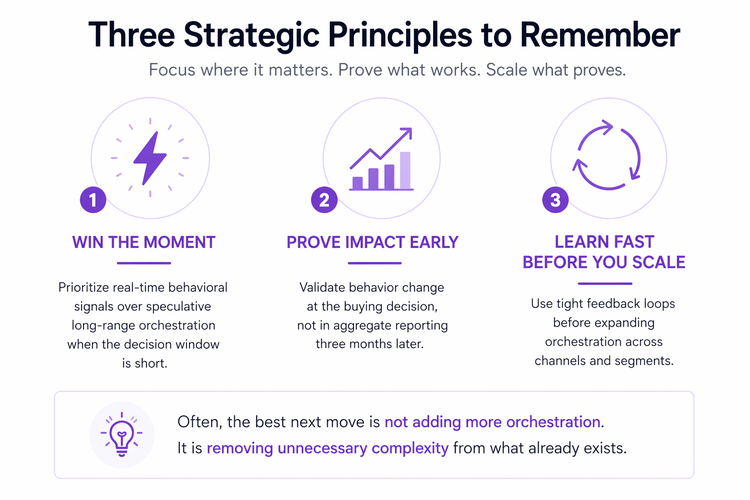
Across the session, three principles held up as the ones worth keeping:
- Win the moment. Prioritize real-time behavioral signals over speculative long-range orchestration when the decision window is short.
- Prove impact early. Validate behavior change at the buying decision, not in aggregate reporting three months later.
- Learn fast before you scale. Use tight feedback loops before expanding orchestration across channels and segments.
Often, the best next move is not adding more orchestration. It is removing unnecessary complexity from what already exists.
Why AI Does Not Remove the Complexity
Agentic and AI-driven systems do not remove decision complexity. They compress it. Clear decisions feed better automation. Unclear decisions feed faster chaos. Automation scales whatever decision quality you already have, including the bad decisions.
This is the part that is easy to miss in the current wave of agent announcements. The promise of AI inside journey tools is real, but the precondition is the same one that has always been true: if the underlying decision logic is fuzzy, adding an autonomous layer on top will not make it sharper. It will make it faster.
What This Means for Teams
For commerce and marketing teams
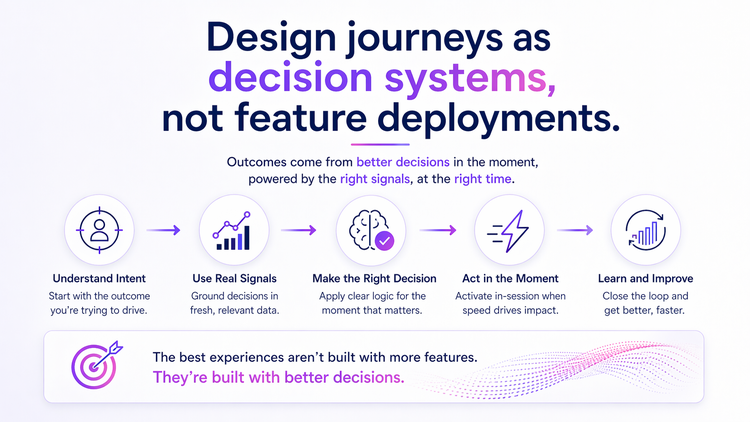
Stop thinking in terms of campaigns and features. Start designing decision systems. For every journey, write down the decision rule, the signal it reads, and the outcome it optimizes for. If the rule cannot be written down, the platform cannot enforce it consistently.
For analytics and data teams
The highest-leverage work is not another dashboard. It is aligning signal definitions across CDP, analytics, and activation tools so that “cart abandon” or “high-intent visitor” means the same thing everywhere. Without that alignment, every downstream decision inherits the drift.
For Adobe partners
The conversation with clients needs to shift from “which features to turn on” to “which decisions are we encoding, and where.” Platform configuration is the easy part. Decision design is where the differentiation lives, and it is the part that does not get solved by a deployment.
For architects
Design the architecture around the decision points, not the channels. The channel is an output. The decision is the asset. When the decision layer is modeled explicitly (rules, signals, policies), swapping or adding channels becomes an execution change rather than a re-architecture.
The takeaway
Connected journeys do not scale through more tools. They scale through better decisions. The teams that move from fragmented execution to consistent, connected experiences are not the ones with the biggest stack. They are the ones who stopped designing journeys as feature deployments and started designing them as decision systems.