Inside Adobe’s Paid Media Controller: What B2B Orchestration Actually Looks Like
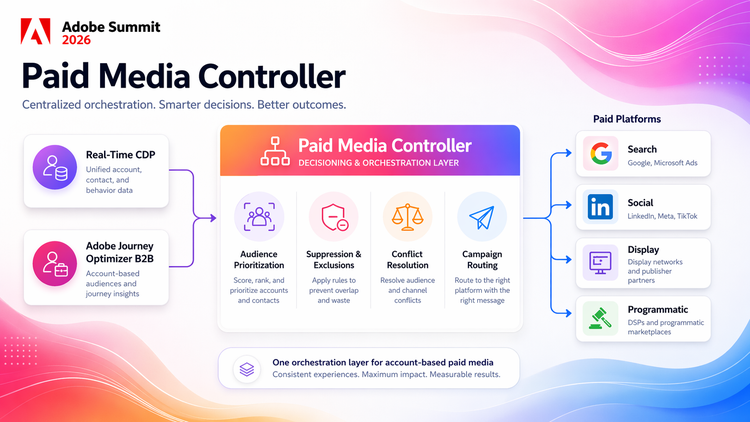
B2B paid media is expensive, operationally complex, and difficult to scale. Every demand generation team knows the story. Spreadsheets for list management. Suppression and exclusion updates that never quite synchronize. Multiple campaigns targeting the same accounts from different corners of the organization. No single view of what is active, for whom, or why.
At Adobe Summit 2026, one of the more honest case-study sessions came from Adobe itself, walking through how the company rebuilt its own B2B paid media operation on top of Real-Time CDP and Adobe Journey Optimizer B2B Edition. The result is a centralized orchestration layer they call the Paid Media Controller. This is what it actually looks like, and why it matters for anyone running account-based programs at scale.
This article covers the core problems it solves, the architecture, the logic that decides which campaign wins when an account qualifies for several, and what changes for the teams on the receiving end.
Paid Media in B2B Is Still a Mess
The Paid Media Controller: One Orchestration Layer
Capabilities the Controller Unlocks
Paid Media in B2B Is Still a Mess
Before the solution, a clear statement of the problem. Paid media in B2B is expensive, operationally complex, and difficult to scale. Four recurring failure modes show up in almost every mid-to-large program:
- Manual list management. Heavy reliance on spreadsheets, frequent suppression and exclusion updates, team handoffs that add time and risk. The lists are stale the moment they are uploaded.
- Unintentional campaign overlap. The same accounts get targeted across multiple campaigns because nothing centrally decides who is allowed to speak to whom. Audience fatigue and wasted spend follow.
- Disconnected systems. Paid media platforms operate in silos. There is no account-level alignment with email, nurture, or sales activity, so the same account sees uncoordinated messaging across channels.
- Lack of prioritization. No clear logic for which campaigns take precedence, which makes it hard to align spend with revenue goals. Everyone competes for the same accounts internally.
None of those problems is a tooling problem on its own. They are what happens when paid media is treated as a channel rather than as part of an orchestrated journey.
The Paid Media Controller: One Orchestration Layer
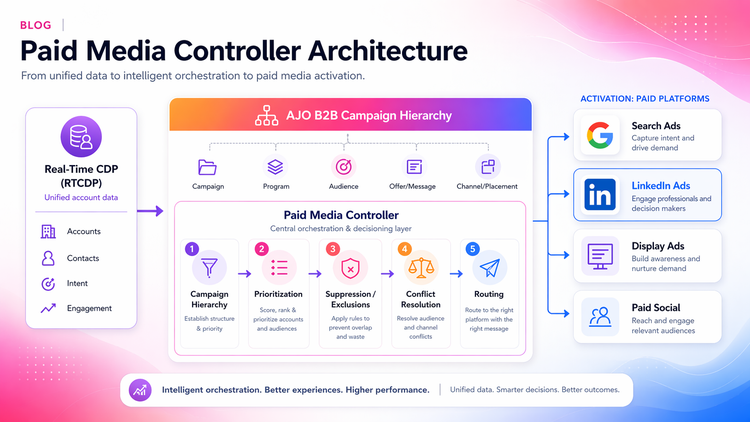
Adobe’s fix was to build a central orchestration layer — the Paid Media Controller — on top of two Experience Cloud foundations: Real-Time CDP for the account data and Adobe Journey Optimizer B2B Edition for the journey logic. The job of the controller is to decide, for every account, which paid campaign it should be in right now.
Single source of truth (RTCDP)
Account-level data lives in RTCDP in a unified form, with real-time audience segmentation that replaces the manual list-building cycle. Suppression, exclusions, and qualifying criteria are expressed as segments and rules, not as spreadsheet rows maintained by a campaign manager.
Account-level journey orchestration (AJO B2B)
Accounts are evaluated against a campaign hierarchy — a waterfall that routes each account into the highest-priority campaign it qualifies for. The hierarchy the team presented runs awareness campaigns at the top, then targeted pursuits, then persona programs, so that a high-priority pursuit account is not wasted on broad awareness and vice versa.
Automated activation
Once the controller has decided which campaign an account belongs in, audiences are pushed directly to paid media platforms like LinkedIn. No manual exports. No handoff to a separate ops team. The activation step is the same whether the audience is a thousand accounts or a hundred.
Real-time visibility
Journey observability shows how accounts are routing, which qualification logic is firing, and how accounts are flowing through campaigns over time. When a campaign is underperforming, the diagnostic is not “something in the funnel is off,” it is “this qualification rule excluded 3,200 accounts this week.”
Capabilities the Controller Unlocks
- Centralized governance. One system owns campaign entry and suppression logic, so the same rules apply everywhere.
- Journey-based orchestration. Paid media becomes a step in a broader customer journey rather than a parallel channel with its own logic.
- Intentional overlap management. Duplicate targeting across campaigns becomes a policy decision, not an accident of who uploaded which list first.
- Omnichannel coordination. Paid media aligns with sales activity, marketing campaigns, and go-to-market priorities instead of running as a siloed budget line.
What This Means for Teams
For demand generation and RevOps
The operational overhead of managing paid media lists should shrink dramatically once suppression and exclusion logic live as rules on top of a unified account profile. The saved time is best spent on the parts that actually change outcomes: qualification logic, creative, and funnel diagnosis.
For B2B marketers
Campaign strategy moves from “what do I target” to “where does this campaign sit in the hierarchy, and what qualifies an account in or out.” That is the shift from media buying to journey design, and it is where the incremental performance is now coming from.
For Adobe partners
This is a repeatable architecture pattern. Most B2B clients have all four of the problems in the opening list. Partners who can assess a client’s current paid media operation and propose a Paid Media Controller on RTCDP + AJO B2B have a credible, reference-backed story to tell.
For architects
The principle generalizes beyond paid media. Any channel that currently operates with its own lists and its own suppression logic is a candidate for the same treatment: unified account data, a single controller that assigns the account to one campaign at a time, and automated activation from there. Once the pattern is in place for paid media, adding other channels is configuration, not re-platforming.
The takeaway
Paid media stops being a mess when it stops being a channel running on its own rails. The Paid Media Controller is not a product. It is a pattern — a centralized orchestration layer that lets unified data and campaign hierarchy decide who gets targeted, where, and in what order. For any B2B team still managing this with spreadsheets, Adobe’s own case study is a useful reference point for what the next step looks like.