Introduction to Adobe Experience Platform (AEP)

Adobe Experience Platform is a modern customer experience management solution that centralizes and standardizes customer data from any source, in (near) real time, for analytics, personalization, and other use cases.
Unlike traditional stacks and MarTech tools with siloed analytics tools, separate CDPs, and third-party DMPs, AEP is an open, API-first system that unifies first- and third-party data into a common model, applies machine learning, and delivers a 360° profile of each user.
In practice, this means you can collect data from multiple datasources (like web, mobile, CRM, offline, partner or 3rd party data, etc.) together and use it for anything from reporting and segmentation to real-time personalization.
High-Level Overview of AEP
Key Takeaways
High-Level Overview of AEP
A high-level view of AEP’s architecture shows multiple ingestion paths (streaming or batch) and outputs to analytics, activation, and activation services. For example, as the diagram below illustrates, you can stream data via the Web SDK and Edge Network or upload batch files to feed the central data lake. Once ingested, data enters the real-time pipeline and profile store for immediate use in analytics or activation.
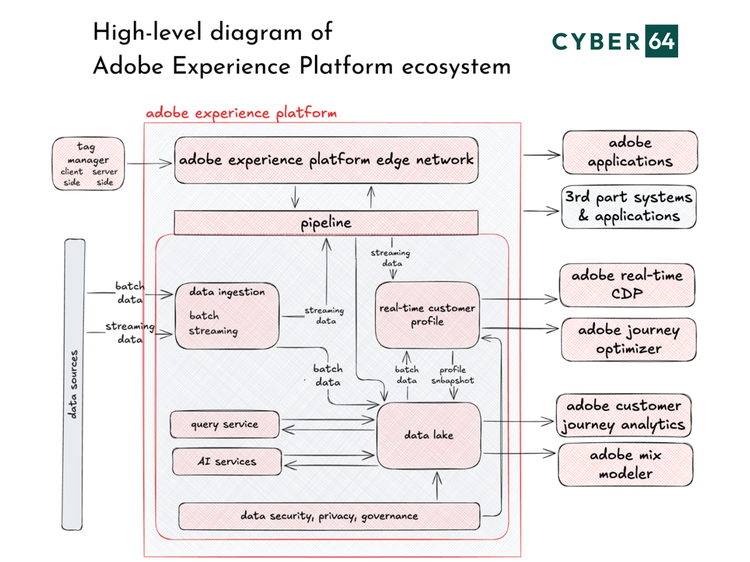
High-level data flow in Adobe Experience Platform illustrates how data can enter from many channels (via the Web SDK/Edge, batch uploads, connectors) and be processed into the real-time profile or sent on to applications like Analytics, Target, or third-party systems.
Key Takeaways
Unified design of AEP contrasts with common legacy models.
- A traditional web analytics tool only tracked clicks and pageviews.
- A DMP only collected anonymous cookie signals for ad targeting.
- A "classic" CDP might stitch together multiple offline sources but often out-of-date.
In contrast, AEP’s streaming, first-party Edge Network and profile service combine those capabilities. Organizations can activate data in real time (for personalization or marketing campaigns) and apply analytics or ML across all touchpoints from one platform.