Your product evolves. Can your documentation keep up?
How do customers use documentation?
What happens when AI gets answers from the wrong sources
What does AI-ready documentation look like
The part nobody budgets for
Where do you start with legacy content?
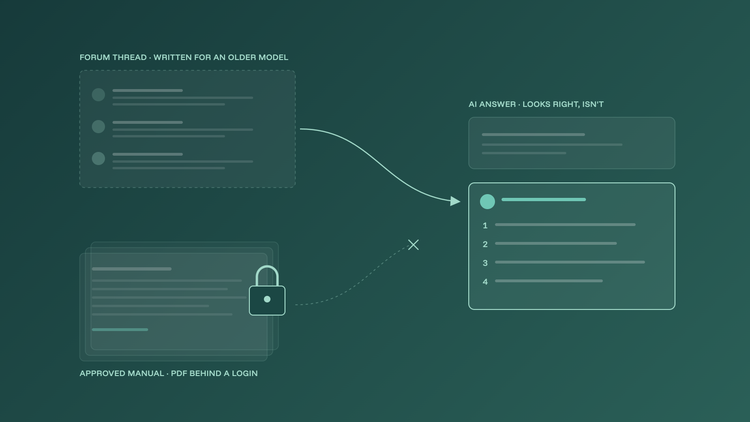
When a machine stops in the middle of a cycle and shows an error code, the operator does what most people nowadays resort to by default: types the code into an AI assistant and asks how to clear it. The manufacturer most likely has the correct procedure, written by its technical writers, reviewed by engineering, and approved for that exact model, but it sits in a 300-page PDF, behind a customer login or in an internal system the assistant can't reach.
So the assistant answers from what it can read, which could just as well be an old forum post written for an even older model. The operator, having no reason to doubt it, follows the steps. The honest question is: is there a better way?
How do customers use documentation?
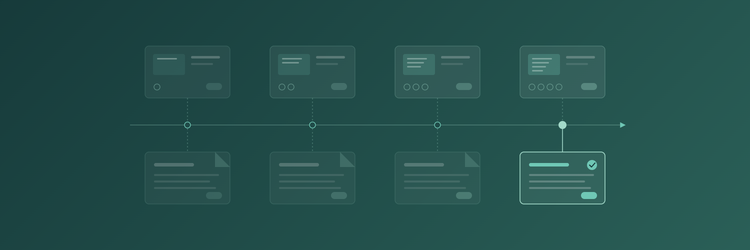
Customers and field technicians rarely read documentation from start to finish. They want one answer or a few steps from wherever they already are, whether that is a search engine, the support chatbot or an AI assistant. Downloading a manual, finding the right chapter, and then checking whether it matches their serial number is the part they will gladly skip.
Let's use an example that pretty much everyone can relate to: a car. Almost nobody reads a car's owner's manual cover to cover; but when a warning light comes on, the driver looks for the one page that explains it. The manual still has to exist, because it is the complete, approved reference that service partners, auditors and the occasional thorough owner rely on.
Product documentation in manufacturing and high-tech works the same way, which means it now has two jobs: delivering the complete manual, as PDF and often in print, and delivering a specific answer to a specific question without anyone having to flip through a document.
Most documentation teams are set up for the first job, and the PDFs they produce are not the problem, since they are still needed. What's missing is the answer layer, and AI fills that gap with sources the company doesn't control. This also pivots the role of documentation itself: long budgeted as a necessary cost of shipping a product, it is now the material AI quotes when a customer asks how to use or fix that product, provided the AI can reach it.
What happens when AI gets answers from the wrong sources
AI assistants don't turn to websites or forums out of preference. They answer from whatever they can read and interpret, and approved documentation usually falls short on one of two counts:
- the first is reach: content in PDFs, customer portals, and internal knowledge systems is largely invisible to public search and to most AI tools, while a forum thread is indexed and easy to read
- the second is ambiguity: a manual published online as long pages, without clear topics or product and version metadata, gives AI no reliable way to tell which instructions apply to which model. It can end up combining steps written for a 2019 controller with steps for the 2024 one, and present the result as a single answer.
The cost rarely appears in the documentation budget, but it shows up elsewhere in the business. Wrong fixes lead to downtime, damaged equipment, and repeat service visits, and customers who followed bad advice still call support, now with a second problem to solve.
On safety-relevant procedures, an inaccurate answer becomes a liability question. Effective from January 20, 2027, the EU Machinery Regulation allows manufacturers to supply the official instructions for use in digital form, so the online version of a manual can be the official version itself.
What this means in practical terms is that keeping it accurate and current becomes a compliance matter as well as a support one. So when a customer asks AI about your product, the answer is effectively brand content, and most marketing teams have little or no control over where it comes from.
What does AI-ready documentation look like
Being online is necessary but not sufficient. Documentation that both people and AI can use reliably has four properties:
- it is online and current, published from the same source as the PDF, so the web version never lags behind
- it is structured as topics, so a procedure, a specification or a troubleshooting step is a self-contained unit with one single purpose
- it carries product and version metadata, so every topic states which models, configurations and releases it applies to
- it is available wherever answers are given: public search, the company's own chatbot, support and partner tools, and the AI assistants customers already use.
The principle underneath is single sourcing. One body of approved content produces both the full manual and the short answers; when engineering changes a procedure, the change is made once and synchronized to every output. Structured content of this kind does not guarantee that an AI assistant will cite it, but it makes approved content reachable and unambiguous, which removes the main reason AI turns to forums in the first place.
Adobe Experience Manager Guides is built for this model. It manages structured DITA content as an extension of AEM, so companies already running AEM extend the platform they have rather than adding a separate documentation stack.
For IT, that means legacy documentation tools can be retired instead of integrated, leaving one governed source of truth and fewer systems to maintain. For the documentation team, it means publishing to the web, PDF and other channels without depending on IT for every release.
Haas Automation, the machine tool manufacturer, is currently running such a transformation. The process includes moving 8,000 web pages, plus content in many other formats, into a single source in AEM Guides, which publishes the same content to its website, to the machine control on the floor, and to PDF.
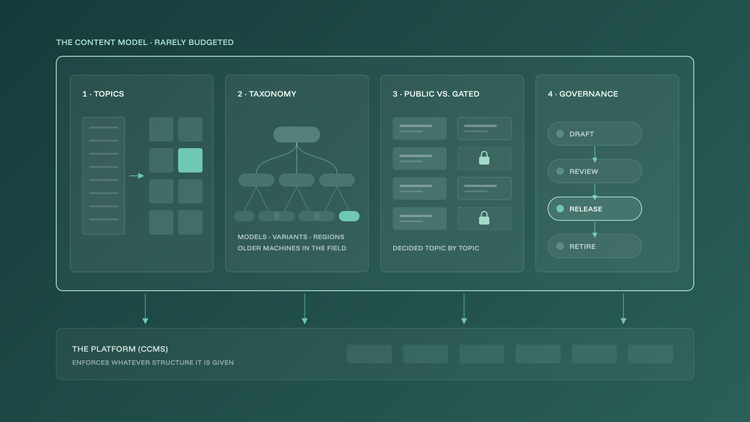
The tool is the more straightforward part of the project. A component content management system (CCMS) doesn't decide how content is organized; it enforces whatever structure it is given, whether that structure is sound or not. The harder part is the content model, which is rarely budgeted as work in its own right.
The content model has to answer four practical questions:
- The first is how manuals are broken into reusable topics. If topics are too coarse, AI still cannot isolate a single answer; if they are too fine, writers spend their time assembling fragments.
- The second is how product and version are tagged, using a taxonomy that reflects how the company actually sells and supports its products, including variants, regional versions, and older models still in the field.
- The third is what is public and what stays behind a login. Some service procedures stay gated for good reasons, such as safety, certification or partner agreements, and the model should make that decision explicitly, topic by topic, rather than leaving everything locked by default.
- The fourth is governance, meaning the review workflows, release states, and retirement rules that decide whether the chatbot quotes this quarter's procedure or last year's.
None of these decisions belong to the documentation team alone. IT owns the platform and its integrations, marketing is responsible for how the brand appears when customers ask about the product, and support knows which questions customers actually ask. A documentation project run in isolation usually produces a cleaner repository that still answers the wrong questions, because the content model was designed without the whole board in view.
Adobe's own partner material describes the DITA content strategist as the most niche role in an AEM Guides practice, and it is where Cyber64 concentrates its work on these projects. That work covers designing the topic structure and taxonomy, defining what is public and what stays gated, and setting up the governance and publishing pipelines so that one source feeds the website, the chatbot and AI assistants.
The platform is then configured around that model, and the project is measured by what happens after launch: whether, a year later, the chatbot is still answering from the current, approved version.
Where do you start with legacy content?
For most manufacturers, the open question is not whether this is worth doing but where to begin when there are thousands of legacy pages, hundreds of PDFs and product lines that have evolved over decades.
Which content should move first, how much should be restructured rather than migrated as it is, and how does the team keep publishing while the migration is underway?
A practical first step is knowing where your documentation stands today. The 10-question Documentation Health Check shows which of these gaps apply to you.
Haas Automation is working through those questions now, and the webinar "Structure Before AI: How Haas Automation Is Making Its Product Content AI-Ready" (Wednesday, December 2, 2026, at 17:00 CET) covers how the migration is planned, run, and what the content model looks like underneath.
Its title also sums up the central topic of this article: get the structure right first, and AI gets approved, current content to answer from.

Martina Mikolić
Subject Matter Expert - AEM Guides | AEM Technical Architect
- @martinaricijas
- martina.ricijas@cyber64.com
FAQ
What is AI-ready documentation?
AI-ready documentation is product content that people and AI tools can both use reliably. It is published online from the same source as the PDF, structured as self-contained topics, tagged with product and version metadata, and available wherever customers look for answers: search, chatbots, partner tools and AI assistants.
Why do AI assistants give customers answers from forums instead of official manuals?
Because they answer from whatever they can read. Manuals locked in PDFs, customer portals or internal systems are largely invisible to them, while forum threads are indexed and easy to parse. When official content is online but unstructured, AI also can't tell which instructions apply to which model.
Does structured documentation guarantee that AI will cite our content?
No. It makes approved content reachable and unambiguous, which removes the main reason AI turns to other sources. Whether a specific assistant cites it still depends on that assistant, but without structure your content rarely stands a chance.
What is single sourcing in technical documentation?
Single sourcing means one body of approved content produces every output: the full manual, the PDF, web pages and short answers for chatbots. When engineering changes a procedure, the change is made once and published everywhere, so no channel lags behind.
What does the EU Machinery Regulation change for product documentation?
From January 20, 2027, the EU Machinery Regulation allows manufacturers to supply official instructions for use in digital form. The online version of a manual can therefore be the official one, which makes keeping it accurate and current a compliance matter, not only a support one.
Where should a manufacturer start with legacy documentation?
With an honest view of where the content stands today: what is current, what is duplicated, what is public and what is gated. From there you decide which content moves first, how much to restructure rather than migrate as is, and how to keep publishing during the transition. The 10-question Documentation Health Check is a quick way to start.