
Haas Tooling Achieves 177% Paid Revenue Growth with Cyber64
The year in four numbers
October 2025 to October 2026 against the same dates a year earlier. Purchases and revenue from GA4, last non-direct click. Platform-reported conversions are not used.
+131%
Total ecommerce revenue, Year-over-year growth
+177%
Google Ads-attributed revenue, Year-over-year growth
+133%
Google Ads-attributed purchases, Year-over-year growth
8x
Google Shopping revenue, Year-over-year growth
The Challenge: Building a Paid Media Strategy for B2B Ecommerce
Most of what is written about ecommerce advertising assumes a consumer shop. Haas Tooling is a different kind of store. It sells cutting tools, workholding, measuring equipment and shop supplies to machine shops, the catalog runs to thousands of SKUs, and the person placing the order usually buys for several machines at once. Weekday traffic is several times higher than weekend traffic, and a large part of the orders come from customers who already buy from Haas in other ways.
Until August 2025, Haas Tooling operated within haascnc.com, the corporate website for Haas machines. Its paid media infrastructure had evolved around this setup rather than the specific needs of a B2B ecommerce business. Machine and tooling campaigns shared a Google Ads account, Shopping contributed less than 5% of paid revenue, European campaigns operated on significantly smaller budgets than the US, and Meta Ads remained largely untapped.
When Haas Automation moved its tooling store to a dedicated domain, haastooling.com, in August 2025, the transition presented an opportunity to rethink its entire paid media approach. The challenge was not to enter new markets, as Haas already served customers across the US and Europe, but to build a scalable advertising infrastructure capable of supporting thousands of products, multiple languages and different purchasing behaviors.
The store serves two regions in eight language variants: English for the United States, and seven European variants for buyers in 25 countries, from Germany and France to Latvia and Malta, with prices in five currencies. Nothing in the paid media setup could be built once and copied. Every product feed, campaign and ad exists per language, so a Dutch machine shop sees Dutch products and a Dutch ad, and a Polish one sees its prices in złoty. Europe is also where most visitors decline analytics cookies, which shaped how the results below could be measured at all.
Measurement added another layer of complexity. Advertising performance relied heavily on platform-reported conversions, while limited analytics consent restricted visibility into customer activity. Haas needed a more reliable way to connect advertising investment with actual business results and make informed budget decisions across channels and markets.
The challenge for Cyber64 was to transform a fragmented paid media setup into a scalable, multilingual advertising operation that could support Haas Tooling's complex B2B ecommerce business while connecting marketing investment to measurable business results.
What we changed
The order of the work mattered as much as the work itself. Product feeds came first, then the account structure, and only after that did the budget grow. The table shows the main changes side by side; shares refer to revenue attributed to Google Ads in GA4.
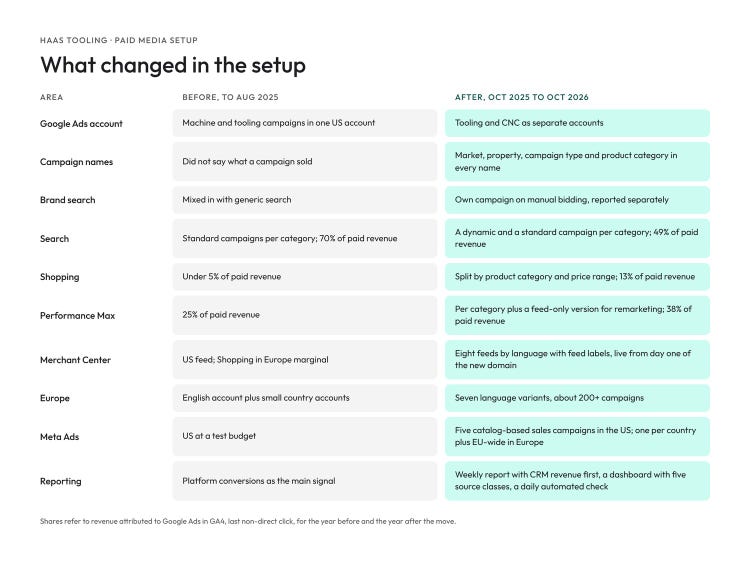
Beyond restructuring campaigns, Cyber64 made Haas Tooling's advertising smarter, more efficient and easier to manage.
- Showing the right products to the right customers. Google Merchant Center was ready from the day the new website launched, with localized product feeds ensuring customers in each market saw relevant product listings in their language.
- Reducing wasted advertising spend. Cyber64 excluded more than 1,500 irrelevant YouTube channels and 160 websites to focus advertising budgets on more relevant placements.
- Spending more when customers are buying. Since Haas Tooling generates significantly more sales during weekdays, Cyber64 introduced automated budget adjustments that reduce advertising spend over weekends and restore it on Mondays.
- Using AI to detect problems early. An AI agent checks advertising accounts against actual website purchases every morning, helping Cyber64 spot tracking discrepancies and potential issues before they go unnoticed for weeks.
Together, these improvements turned day-to-day campaign management into a more automated, data-driven operation aligned with how Haas Tooling's customers actually shop.
How the CRM data comes in
Every week Haas receives a report with three data sources, and the first page shows revenue from the SAP CRM, before any web analytics. The export is done by hand each week and loaded into the same BigQuery project where the web data already sits. GA4 is then used to explain which channels moved, while the CRM figure is the one that says what was actually booked. We never add the two together, and every page in the report says which source it is based on.
The same export also feeds a Marketing Performance Dashboard that we built in-house, using Claude Code for the development. It is a single page with eight views, from the week at a glance to how credit is shared between channels. The rule that took longest to agree on had nothing to do with charts. Every figure in the dashboard is labelled with one of five source classes, so the reader always knows whether a number is booked money or a platform's own claim:
- actual orders from SAP, the money that was booked
- the ad platform's own figures
- website activity we measure directly
- measured activity plus Google's estimate for visitors who declined cookies
- cookie-accepting visitors only, where the mix is reliable and the totals are low
The customer master from the CRM is what makes the term new customer usable at all. The website flag, the ad platform's flag and the CRM disagree on who counts as new. The dashboard shows all three next to each other and calculates acquisition cost against the CRM's definition, separately for the US and for Europe, because a new customer does not cost the same in both regions.
Haas Tooling can now see what advertising actually delivers, not just what Google or Meta reports. By connecting advertising performance with real sales data, the team can identify which channels bring in revenue, how much it costs to acquire new customers, and where to invest its marketing budget for better results.
Five source classes behind every number
Ordered from the figure closest to booked money to the one furthest from it. The weekly report and the dashboard label every number with its class.
Actual SAP orders
Real orders booked in the CRM. The money that was actually earned, online and offline.
Directly measured
Website activity we can see and count in GA4 and BigQuery.
Measured plus estimated
What we see, plus Google's estimate for visitors who declined cookies.
Cookie-accepting visitors only
The mix is reliable, the totals are lower than reality.
The ad platform's own figures
What Google and Meta report about themselves. Useful for bidding, never the basis for a budget decision on its own.
The customer master from the CRM is what makes the term new customer usable at all. The website flag, the ad platform's flag and the CRM disagree on who counts as new. The dashboard shows all three next to each other and calculates acquisition cost against the CRM's definition, separately for the US and for Europe, because a new customer does not cost the same in both regions.
Results after one year
One year after the transition, Haas Tooling achieved significant growth in online sales and paid media performance across the US and Europe.
The results below compare October 2025–October 2026 with the previous 12-month period, using website analytics and advertising investment data to measure performance.
- Online store purchases, all channels: +99%. Online store revenue: +131%.
- Google Ads share of store revenue: 21.0% to 25.2%
- Revenue from Shopping campaigns: +717%
- Revenue from Performance Max: +325%
- Revenue from Search campaigns: +92%
- Shopping and Performance Max share of paid revenue: 29% to 51%
- Average order value of paid orders: +19%
- Google Ads investment: 2.6x
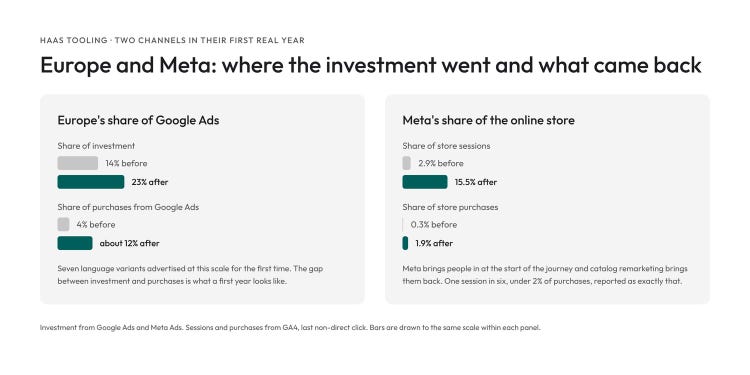
- Europe share of Google Ads investment: 14% to 23%
- Europe share of Google Ads purchases: 4% to about 12%
- Meta Ads investment, US: 25x
- Meta Ads investment, Europe: +129%
- Paid social share of store sessions: 2.9% to 15.5%
- Paid social share of store purchases: 0.3% to 1.9%
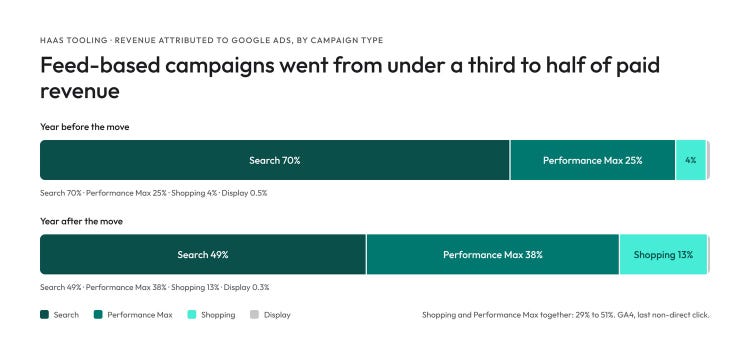
The way the growth is distributed tells more than the total. Search, which was already the mature part of the account, grew its revenue by 92 percent. Shopping and Performance Max, the two campaign types that depend on the product feed, went from under a third of paid revenue to half. That is the feed work from the first week showing up in the numbers a year later. From March to September 2026, every month produced at least twice as many paid purchases as the same month a year earlier, and December was close to three times.
European campaigns also gained momentum. Following the transition, Europe's share of Google Ads-attributed purchases increased from 4% to approximately 12%, while accounting for 23% of total Google Ads investment. With campaigns now running across seven language variants at a significantly larger scale, Haas Tooling established a stronger paid media presence across its existing European markets, creating a foundation for further growth.
Meta Ads also developed into a more established marketing channel. Paid social now drives approximately one in six website visits, although it accounts for less than 2% of purchases. This reflects its role in the customer journey: introducing potential buyers to Haas Tooling and bringing them back through remarketing campaigns. Rather than measuring Meta solely by direct sales, Cyber64 evaluates its contribution to customer engagement and the broader purchasing journey.
Beyond Revenue Growth: Building a Foundation for Long-Term Performance
For Haas Tooling, the transformation went beyond increasing advertising revenue. Cyber64 helped establish a more structured, scalable and measurable paid media operation, designed around the specific needs of B2B ecommerce.
The project demonstrated three important principles:
- Better data leads to better decisions. Connecting advertising performance with actual CRM sales gives Haas Tooling a clearer understanding of which channels generate revenue, how much new customers cost and where to invest next.
- Strong foundations make growth possible. Restructured campaigns, localized product feeds and a stronger Google Shopping and Performance Max setup helped Haas Tooling scale advertising across the US and Europe.
- Automation makes performance easier to manage. From adjusting budgets to match purchasing patterns to using AI for daily performance monitoring, Cyber64 introduced processes that reduce manual work and help identify potential issues earlier.
One year after the transition to haastooling.com, Haas Tooling achieved 131% growth in total online store revenue and 177% growth in Google Ads-attributed revenue, alongside a more transparent and scalable advertising operation.
The result is not just stronger paid media performance today, but a foundation for more informed investment decisions and continued growth.
For B2B ecommerce businesses managing complex product catalogs and multiple markets, the lesson is clear: sustainable growth requires more than increasing advertising budgets. It starts with the right infrastructure, reliable measurement and a strategy built around how customers actually buy.
An award-winning project
Cyber64’s work with Haas Tooling was recognized with a MIXX Award for Best Export Platform, highlighting the impact of the e-commerce transformation across performance, scalability, and growth.

Work
Each of our projects starts with a business problem. Here's what happens next.
Haas Tooling
E-commerce | AEM | Performance & Optimization



Haas Automation
Automation | E-commerce